Budget season has arrived for Nigerian companies with December year ends. Boards want the 2027 budget approved before the holidays. Finance teams are pulling together sales forecasts, cost estimates and capital plans. And this year, the assumptions behind those numbers matter more than usual.
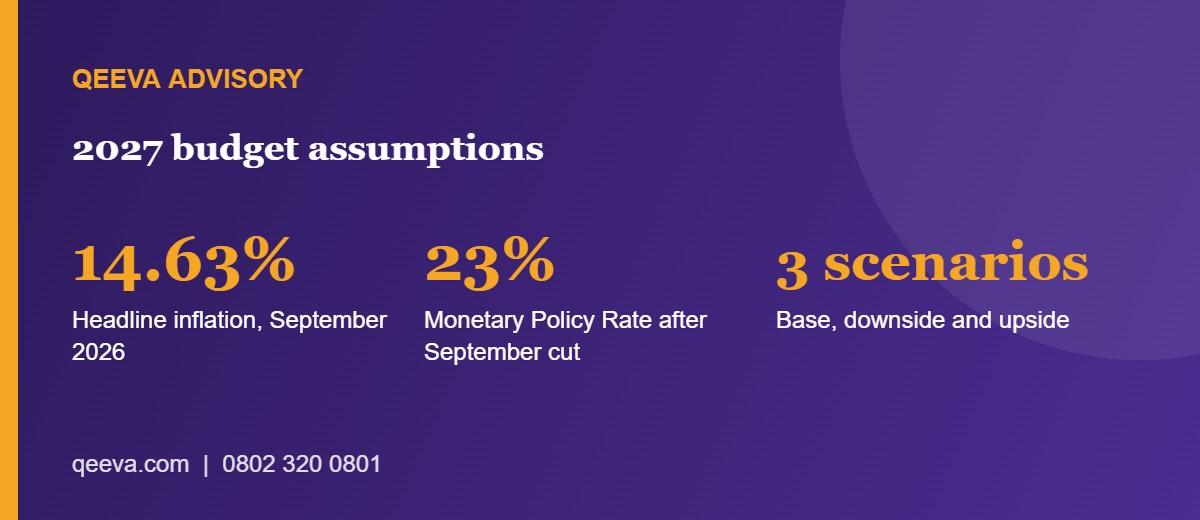
2027 opens with general elections in January. Inflation has fallen to 14.63% in September 2026, its lowest level since 2020, but remains high by any standard. The Central Bank cut the Monetary Policy Rate to 23% in September, and the Monetary Policy Committee meets again on 23 and 24 November. The naira traded near ₦1,347/$ in early November, more stable than a year ago, but with a federal budget deficit of ₦29.2 trillion and new foreign borrowing requests, few analysts expect that stability to be guaranteed. The Nigeria Tax Act 2025 is completing its first year.
A budget built on last year’s numbers plus 10% will not survive this environment. This guide explains how to set assumptions for an election year, build scenarios, and turn the budget into a management tool rather than a ritual.
Start with the assumptions, not the spreadsheet
Most budgeting problems start with weak assumptions. Before anyone opens a template, the finance team and management should agree a short assumptions sheet. It should cover:
| Assumption | 2027 considerations |
|---|---|
| Inflation | Headline inflation of 14.63% in September 2026. Consider a base case and an upside risk case, especially for food and energy-heavy cost bases |
| Exchange rate | Stability near ₦1,347/$ in late 2026, but deficits and post-election policy create risk. Model at least two rates |
| Interest rates | MPR at 23% after the September cut. Further cuts are possible but not certain |
| Sales volumes | Consumer demand under pressure in many categories, with households protecting essentials |
| Prices | Room for price increases is narrowing in consumer markets |
| Wages | Pay pressure from inflation and the new PAYE rules |
| Energy | Diesel, gas and grid tariffs remain major cost drivers |
| Tax | First full year of computations under the Nigeria Tax Act 2025, including the 4% Development Levy for companies that are not small |
Write each assumption down, note its source, and get management to sign off before the detailed budget begins.
Plan for the election calendar
Elections affect business in predictable ways.
Demand shifts. Campaign spending can lift demand for some goods and services, including printing, media, transport, food and hospitality, in the months before the vote. Other sectors see customers delay decisions until results are known.
Operational disruption. Movement restrictions on election days, security concerns and protests in some areas can close outlets and disrupt logistics for days.
Investment pauses. Investors and lenders often wait for clarity before committing capital. Expect fundraising and large contract awards to slow from December 2026 to February 2027.
Policy uncertainty. New administrations or changed priorities after elections can bring new policies on taxes, tariffs, foreign exchange and spending.
Build these effects into the monthly phasing of the budget, not just the annual totals. A January sales forecast that matches January 2026 ignores the election effect.
Build three scenarios
A single-point budget gives false precision. Build three scenarios:
- Base case. The most likely outcome given current information.
- Downside case. Weaker demand, a weaker naira, higher input costs and slower collections.
- Upside case. Faster rate cuts, stable currency and stronger demand.
For each scenario, show revenue, gross margin, operating costs, EBITDA, cash flow and borrowing needs. Then agree what management will do if the downside case starts to happen. For example, which costs will be cut, which capital projects will be delayed, and which credit lines will be drawn.
Budget the cash, not only the profit
Profitable companies run out of cash every year in Nigeria. A budget must include a monthly cash flow forecast covering:
- Collection periods by customer group, adjusted for expected delays around elections.
- Supplier payment terms, including any that require advance payment for imports.
- Tax payments, including company income tax, the Development Levy, VAT and PAYE.
- Loan repayments and interest.
- Capital spending.
- Dividends.
Identify the months where cash is tightest and arrange facilities before they are needed. Banks are slower to approve new lines in election periods.
Zero-base the biggest cost lines
Incremental budgeting adds a percentage to last year’s costs. Zero-based budgeting asks managers to justify each cost from scratch. Full zero-based budgeting is time-consuming, but applying it to the five or six largest discretionary cost lines often yields significant savings.
Good candidates include:
- Marketing and promotions.
- Travel and entertainment.
- Consultancy and professional fees.
- Fleet and fuel.
- Facilities and generators.
- IT subscriptions and software licences.
Ask what each cost delivers, whether it is still needed, and whether a cheaper option exists.
Link the budget to strategy
A budget should fund the company’s priorities. Before allocating resources, management should agree the three to five goals for 2027. Examples include entering a new region, launching a product, improving margins, or preparing for a capital raise. Then check that the budget allocates money and people to those goals. If the strategy says “grow in the North” but the budget has no money for northern distribution, the strategy is wishful thinking.
Set targets people can own
Break the budget down to the level where managers control results. A sales manager should own a revenue and collections target. A plant manager should own production costs and efficiency. A branch manager should own branch contribution.
Agree targets with managers rather than imposing them. Targets that managers believe are achievable get more commitment than numbers handed down from head office.
Monitor monthly and reforecast quarterly
A budget is only useful if it is used. Set up:
- Monthly management accounts comparing actual results with budget, with explanations for significant variances.
- Key performance indicators for sales, margins, collections, inventory and cash.
- Quarterly reforecasts that update the full-year outlook based on actual results and new information.
In 2027, the first quarterly reforecast after the elections will be especially important. Policy changes and market reactions may require significant adjustments.
A worked example
A Lagos distributor of building materials prepared its 2027 budget in November. Its first draft assumed 18% revenue growth, a flat exchange rate and January sales in line with January 2026.
The finance team tested the draft against three scenarios. In the downside case, with the naira at ₦1,550/$, January and February sales 25% lower because of the elections, and collections slowing by 15 days, the company would breach its overdraft limit in March.
Management responded by negotiating an additional facility in December, delaying a warehouse expansion until the second quarter, building extra stock of fast-moving items before the elections, and setting a collections incentive for the sales team. The board approved the budget with a clear trigger list for downside actions.
Figures are illustrative.
Common mistakes
- Starting with last year’s numbers instead of agreed assumptions.
- Using one exchange rate and one inflation rate for the whole year.
- Ignoring the election calendar in monthly phasing.
- Budgeting profit but not cash.
- Setting targets without consulting the managers responsible.
- Approving the budget and never looking at it again.
Capital expenditure in an uncertain year
Capital budgets need extra discipline in 2027. Imported equipment is priced in dollars, financing costs remain high despite the recent rate cut, and post-election policy could change import duties or foreign exchange access.
Rank proposed projects into three groups:
- Must do: safety, regulatory compliance and replacement of failing critical assets.
- Should do: projects with strong returns that support the strategy.
- Could do: projects that can wait without serious harm.
Approve the first group, release the second in stages tied to performance, and hold the third until the outlook is clearer. For each project, show the payback period and net present value using a realistic discount rate. With borrowing costs in Nigeria well above 20%, projects that looked attractive at lower rates may no longer pay back.
Pricing decisions belong in the budget
Many budgets assume prices will rise with inflation. In 2026 that assumption failed for several consumer goods companies, whose volumes fell as shoppers cut back. Treat pricing as a decision, not an assumption:
- Review price elasticity for major products. Which can bear increases and which will lose volume?
- Consider pack sizes and price points that fit squeezed customers.
- Plan the timing of increases to avoid launching them during election disruption.
- Agree pricing authority and approval limits for the sales team.
Sector notes for 2027 budgets
Manufacturing. Budget energy costs carefully, including diesel and gas. Model raw material import costs at more than one exchange rate.
Retail and FMCG. Expect continued pressure on volumes and higher promotional spending. Budget promotions with clear return targets.
Professional services. Plan for slower decision-making by clients around elections. Pipeline conversion may slip from the first quarter to the second.
Construction and real estate. Building material prices and financing costs drive margins. Build in contingencies on fixed-price contracts.
Technology and fintech. Funding remains concentrated in fewer companies. Budget for runway that does not assume a new raise in the first half of 2027.
Presenting the budget to the board
Boards approve budgets they understand. A strong board pack contains:
- A one-page summary of the key numbers and the main assumptions.
- The three scenarios and the triggers for downside actions.
- A monthly cash flow forecast with peak borrowing needs.
- Capital projects ranked by priority.
- Key risks and how management will respond.
- Comparison with the current year’s actual results.
Keep the detail in appendices. Directors should be able to grasp the plan in ten minutes and challenge the assumptions that matter.
A budget calendar for December year ends
- Early November: agree assumptions and strategic priorities.
- Mid November: issue templates and guidance to managers.
- Late November: collect departmental budgets and review them.
- Early December: consolidate, build scenarios and test cash flow.
- Mid December: board review and approval.
- January: load approved budgets into the accounting system and brief managers on their targets.
Companies that start late tend to approve rushed budgets that nobody uses.
Frequently asked questions
What inflation rate should Nigerian companies use for 2027 budgets?
Use current data as a starting point. Headline inflation was 14.63% in September 2026. Build a base case and a higher-inflation scenario, and adjust for your own cost base, which may differ from headline inflation.
How should companies budget for exchange rate risk?
Model at least two exchange rates, a base case near current levels and a weaker-naira scenario, and show the effect on costs, prices and margins for each.
How do elections affect business budgets?
They can shift demand, disrupt operations around voting days, delay investment decisions and bring policy changes. Phase the monthly budget to reflect these effects.
What is zero-based budgeting?
A method where each cost must be justified from scratch rather than based on last year’s spending. Many companies apply it to their largest discretionary cost lines.
How often should a budget be reviewed?
Compare actual results with budget monthly and update the full-year forecast every quarter.
How should companies budget for capital projects in 2027?
Rank projects into must do, should do and could do groups, approve essential projects, release growth projects in stages, and test each project with realistic discount rates given current borrowing costs.
How Qeeva Advisory can help
Qeeva Advisory Limited helps Nigerian companies build budgets, scenario models and cash flow forecasts, analyse budget variances and set up management reporting. We facilitate budget workshops with management teams and present budgets to boards. See our budgeting, budget analysis and financial planning service and financial advisory services.
Build a 2027 budget that holds up: call 0802 320 0801 or 0807 576 5799, email info@qeeva.com, or visit www.qeeva.com.
This article is general information, not financial advice.