A Nigerian company that needs ₦500 million for six months has three usual options. It can draw an overdraft priced off a monetary policy rate that sat at 26.5% for most of 2026. It can stretch suppliers and damage relationships. Or it can borrow directly from pension funds, asset managers and treasury desks by issuing commercial paper.
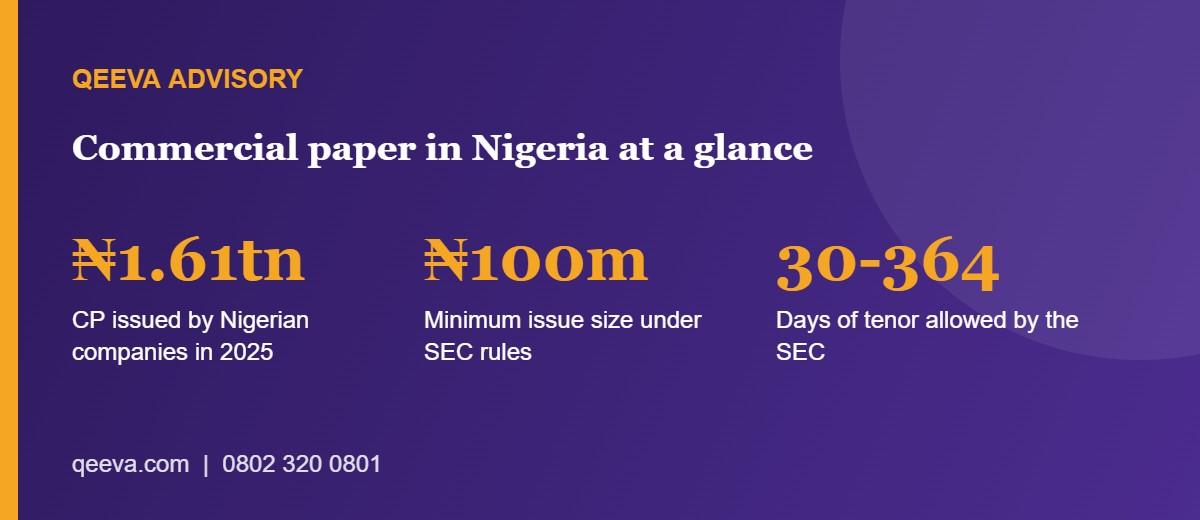
Commercial paper (CP) is no longer a tool for blue-chip companies alone. Corporate Nigeria issued ₦1.61 trillion of commercial paper in 2025, up from ₦1.15 trillion in 2024, according to Nairametrics analysis of FMDQ data. In the third quarter of 2026, 23 issuers targeted ₦446.1 billion across 43 series, including fintechs and mid-sized trading groups.
The rules also changed. The Securities and Exchange Commission (SEC) issued new Rules on the Issuance of Commercial Papers in December 2024 and began processing applications through its e-portal from 1 July 2025. Every CP now needs prior SEC approval.
This guide explains who can issue, what the rules require, what it costs, and how to prepare your company before you approach a sponsor.
What commercial paper is
Commercial paper is a short-term, unsecured promissory note. The issuer sells it at a discount to face value and repays the face value at maturity. The difference is the investor’s return.
A ₦1 billion CP issued at a 20% discount rate for 180 days raises less than ₦1 billion on day one. The company repays ₦1 billion on maturity. Investors include pension fund administrators, asset managers, insurance companies, banks and high-net-worth individuals.
Companies use CP to fund working capital, inventory, receivables and bridge needs. It is not suitable for long-term assets such as plant or property.
The regulatory framework
Three sets of rules apply.
| Rule | Regulator | Key points |
|---|---|---|
| SEC Rules on Issuance of Commercial Papers (December 2024) | SEC | Prior SEC approval for every CP, tenor 30 to 364 days, minimum ₦100 million, investment-grade rating, sponsor required |
| CBN Guidelines on Bankers’ Acceptances and Commercial Papers (September 2019) | CBN | Applies mainly to banks and CBN-regulated issuers, tenor 15 to 270 days, paying agent must be a bank |
| FMDQ Commercial Paper Registration and Quotation Rules | FMDQ Exchange | Quotation requirements, sponsor membership, issuer eligibility |
The SEC rules now set the market standard. Third-quarter 2026 issues ran to 364 days, which reflects the SEC tenor rather than the older 270-day cap in the CBN guidelines. FMDQ suspended CP admissions in December 2024 while the new SEC regime bedded in. Confirm current FMDQ requirements with your sponsor before you start.
Who can issue under the SEC rules
The December 2024 rules set clear eligibility tests.
| Requirement | SEC standard |
|---|---|
| Operating history | At least 5 years |
| Audited accounts | 3 years, with the latest no more than 9 months old |
| Credit rating | Investment grade from an SEC-registered rating agency, maintained to maturity |
| Minimum issue size | ₦100 million |
| Tenor | 30 to 364 days, including rollovers |
| Rollovers | Maximum of two, each with written investor consent |
| Retail offers | Shareholders’ funds of at least ₦500 million, unimpaired by losses |
| Sponsor | SEC-registered Issuing and Placing Agent (IPA) or Issuing, Placing and Collecting Agent (IPCA) |
The rating requirement filters out most companies. An investment-grade rating needs clean audited accounts, stable cash flows, sound governance and manageable leverage. Companies that fail the test can still issue if a bank or other strong party guarantees the paper, subject to the rules in force.
The issuance process step by step
- Appoint advisers. Engage a sponsor (IPA or IPCA), a rating agency, a legal adviser, an auditor and a paying agent.
- Obtain a rating. The rating agency reviews financials, management, governance and industry risk. Budget several weeks for this stage.
- Prepare documents. The sponsor drafts the programme memorandum, pricing supplement and deed of covenant. The auditor and legal adviser provide comfort.
- File with the SEC. The sponsor files on the SEC e-portal. The rules provide for approval within 24 hours where the file is complete.
- Open the offer. The offer must open within 5 days of approval. A private placement runs up to 5 working days and a public offer up to 10.
- Allot and settle. Investors pay, the CPs are lodged with the depository and, if listed, quoted within 7 days of allotment.
- Report. The sponsor files a completion report with the SEC within 10 working days.
- Maintain. File quarterly reports, keep the rating current and give rollover notice before maturity.
The SEC rules impose penalties for breach, reported at ₦5 million plus ₦50,000 for each day the breach continues.
What it costs
CP pricing follows the government yield curve and the issuer’s credit quality.
| Benchmark | Figure | Source date |
|---|---|---|
| Average CP discount rate, 2025 | 22.38% | Nairametrics, February 2026 |
| Average CP tenor, 2025 | 233 days | Nairametrics, February 2026 |
| Implied yield, 180-day CP, Q3 2026 | About 19% | Nairametrics, October 2026 |
| Implied yield, 364-day CP, Q3 2026 | About 23% to 24.75% | Nairametrics, October 2026 |
| CBN monetary policy rate | 23% after the 22 September 2026 cut from 26.5% | CBN, September 2026 |
On top of the discount, budget for arrangement fees, rating fees, legal fees, SEC and quotation fees, and paying agent charges. These costs are largely fixed. They make small issues expensive per naira raised. A ₦100 million issue carries a much higher effective cost than a ₦2 billion programme with the same fees.
The September 2026 rate cut lowered the benchmark. If yields follow, CP becomes cheaper relative to bank credit, and more mid-sized companies will find it worth the effort.
Worked example
This example is illustrative. The company and figures are invented for explanation.
Kola Foods Limited is a food processing company with annual revenue of ₦18 billion. It has eight years of audited accounts and an investment-grade rating. It needs ₦2 billion for 180 days to buy raw materials ahead of peak season.
Option A: bank overdraft. The bank offers a facility at 28% a year. Interest for 180 days on ₦2 billion is about ₦276 million.
Option B: commercial paper. Kola Foods issues ₦2 billion face value of 180-day CP at an implied yield of 19%. The table shows the economics.
| Item | ₦ million |
|---|---|
| Face value repaid at maturity | 2,000 |
| Cash raised at 19% yield for 180 days | About 1,830 |
| Financing cost (discount) | About 170 |
| Estimated issuance costs (illustrative) | 25 |
| Total cost | About 195 |
The CP route saves about ₦80 million before tax compared with the overdraft. Kola Foods also diversifies its funding and builds a track record with institutional investors. Note that the CP raises about ₦1.83 billion in cash, so the company must size the issue slightly above its cash need or fund the gap from operations.
The saving disappears if the company cannot repay or roll over at maturity. CP investors expect repayment on the due date. A company that funds long-term assets with 180-day paper takes refinancing risk.
Commercial paper compared with other short-term funding
| Option | Typical use | Security | Speed | Main drawback |
|---|---|---|---|---|
| Bank overdraft | Day-to-day working capital | Often secured or guaranteed | Fast once approved | Cost tracks bank pricing, renewable at bank’s discretion |
| Bank term loan | Asset purchase, longer needs | Usually secured | Weeks | Covenants and collateral |
| Invoice discounting | Receivables from strong buyers | Receivables | Fast | Limited to approved invoices |
| Commercial paper | Working capital, bridge funding | Unsecured | Weeks for first issue, faster for later series | Needs rating, fixed costs, refinancing risk |
| Equity | Growth, long-term needs | None | Months | Dilution |
Commercial paper works best alongside a bank line, not instead of one. A standby bank facility gives investors comfort that the company can repay at maturity even if market conditions tighten.
What rating agencies look at
The rating decides whether you can issue and at what price. Agencies assess four broad areas.
- Business risk. Market position, customer concentration, supplier dependence, foreign exchange exposure and the strength of the industry.
- Financial risk. Revenue growth, margins, cash conversion, leverage, interest cover and liquidity. Agencies look at three to five years of audited history and management forecasts.
- Governance. Board composition, independence, audit committee, related-party transactions, succession and the quality of financial reporting.
- Liquidity and refinancing. Committed bank lines, cash buffers and the maturity profile of all debt, including the proposed CP.
Prepare for the review the way you would prepare for an audit. Reconcile your numbers, document your policies, and make sure management can explain every variance in the forecast.
Obligations after issue
Issuing the paper is the start of a relationship with the market. The SEC rules require quarterly reporting through the sponsor and timely rollover notices. The rating agency monitors the issuer and can downgrade it. A downgrade below investment grade breaches the rating requirement and closes the market to future issues.
Build these obligations into your finance calendar. Assign one person to own investor reporting. Track each series maturity at least 30 days ahead, and agree repayment funding with your bank before you need it.
Is your company ready?
Use this checklist before you call a sponsor.
- At least five years of operations and three years of audited accounts.
- Latest audited accounts signed within nine months of year end.
- A clear, recurring cash cycle that repays short-term debt.
- Debt service coverage and leverage within lender norms.
- A functioning board, audit committee and internal controls.
- Clean credit bureau records for the company and directors.
- Up-to-date tax and regulatory filings.
- A management team that can present a credible business plan to a rating agency.
Common mistakes
- Using CP to fund long-term assets and creating a refinancing gap.
- Approaching a rating agency with late or qualified audited accounts.
- Underestimating fixed issuance costs on small issues.
- Assuming rollover is automatic. The SEC rules limit rollovers to two and require investor consent.
- Ignoring the SEC approval step and relying on old FMDQ-only practice.
- Presenting optimistic forecasts without a credible business plan and cash flow model.
- Leaving tax treatment of the discount untested. Take advice on withholding tax and deductibility before issue.
Frequently asked questions
What is the minimum amount a company can raise through commercial paper in Nigeria?
The SEC rules set a minimum issue size of ₦100 million. Fixed costs mean larger issues are more efficient, so many companies set up a programme and draw down in series.
How long can a commercial paper run in Nigeria?
Under the December 2024 SEC rules, tenor runs from 30 to 364 days, including rollovers. The CBN guidelines for banks and CBN-regulated issuers set 15 to 270 days.
Does a company need a credit rating to issue commercial paper?
Yes. The SEC rules require an investment-grade rating from an SEC-registered rating agency, maintained until maturity. Companies without a strong rating may need a guarantee from a bank or another highly rated party.
How long does it take to issue commercial paper?
Rating and documentation usually take several weeks. Once the file is complete, the SEC rules provide for approval within 24 hours, and the offer must open within 5 days.
Can an SME issue commercial paper?
An SME can issue if it meets the SEC tests, including five years of operations, three years of audited accounts and an investment-grade rating. Many SMEs are better served by bank lines, invoice finance or equity crowdfunding until they build that track record.
How Qeeva Advisory can help
Qeeva Advisory helps Nigerian companies raise capital and prepare for investor scrutiny. We build bankable business plans and financial models, prepare companies for credit rating reviews, review governance and controls, value businesses and liaise with sponsors and investors. We also support budgeting, salary grading, background checks, company formation and debt recovery.
See our corporate finance, capital raising and transaction advisory service, our business plan service and our debt and equity placement service for more.
To assess whether commercial paper fits your funding plan, call 0802 320 0801 or 0807 576 5799, email info@qeeva.com, or visit qeeva.com.
Sources: SEC Rules on Issuance of Commercial Papers, Nairametrics on 2025 CP issuance and Nairametrics on the September 2026 MPR cut.
This article is general information at November 2026. It is not investment or legal advice. Speak to a qualified adviser before raising capital.