
Who really owns your company? Nigerian law now expects a clear answer on the public record. Since the Corporate Affairs Commission (CAC) opened its central register of persons with significant control in May 2023, every company must disclose the individuals who ultimately own or control it. Anyone can search the register.
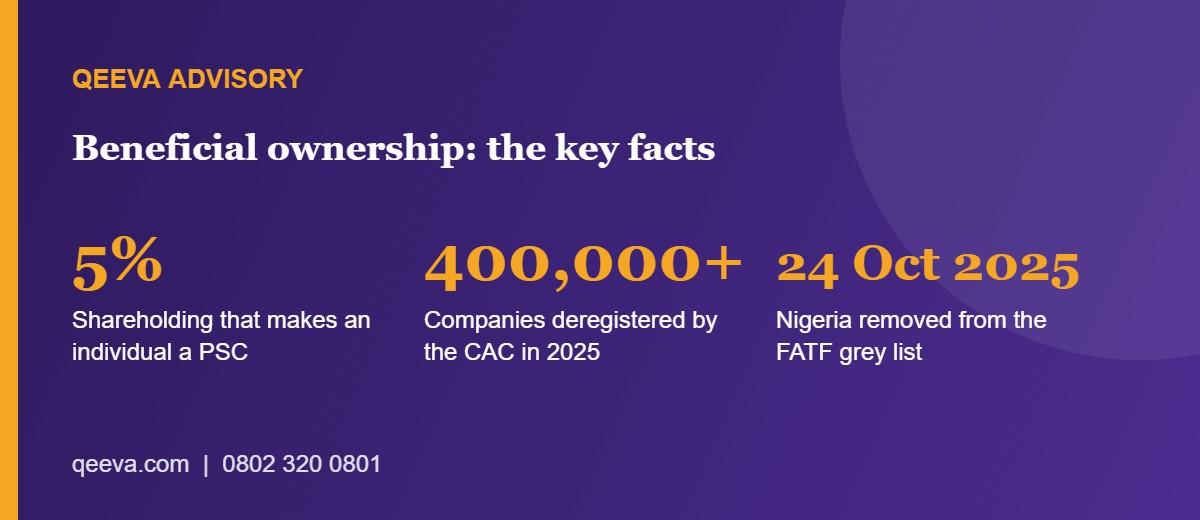
The CAC is enforcing its filing rules. Registrar-General Hussaini Magaji said in February 2026 that the Commission deregistered more than 400,000 companies in 2025 for failing to file annual returns. Beneficial ownership details now travel with incorporation documents and annual returns, so a company that ignores them risks being marked inactive and losing access to CAC services.
The wider context matters too. The Financial Action Task Force removed Nigeria from its grey list on 24 October 2025. Banks, investors and foreign partners now expect clean ownership records as part of customer due diligence. A gap on the CAC register can delay a bank account, a loan or a contract.
This guide explains who counts as a person with significant control, what to file and when, the penalties, and how to clean up your records.
The legal framework
| Instrument | Effect |
|---|---|
| Companies and Allied Matters Act 2020, section 119 | Duty to disclose persons with significant control, CAC to keep a register |
| CAMA 2020, section 868 | Definition of a person with significant control |
| Persons with Significant Control Regulations 2022 | Detailed rules on thresholds, notices, timelines and penalties |
| Money Laundering (Prevention and Prohibition) Act 2022 | Banks and designated businesses must identify and verify beneficial owners of customers |
| CBN guidance on ultimate beneficial ownership (2023) | Expectations for banks on legal persons and arrangements |
The CAC published its notice on PSC notification obligations in September 2022, and the Minister approved the Regulations in November 2022.
Who is a person with significant control
A person with significant control (PSC) is an individual who meets one or more of these tests in relation to a company.
- Holds at least 5% of the shares, directly or indirectly.
- Holds at least 5% of the voting rights, directly or indirectly.
- Has the right to appoint or remove a majority of the directors.
- Otherwise has the right to exercise, or actually exercises, significant influence or control.
The word “indirectly” matters. If a Nigerian company is owned by a holding company in Mauritius, which is owned by a family trust, the PSC is the individual at the top of that chain, not the Mauritius company.
What to file and when
The timelines below come from the PSC Regulations as summarised by Nigerian law firms. Confirm them against the Regulations before relying on them for a specific filing.
| Step | Deadline |
|---|---|
| PSC informs the company after becoming a PSC | Within 7 days |
| Company files PSC details or changes with the CAC | Within one month of receiving the information |
| Person served with a disclosure notice responds | Within 7 days |
| Company files a restriction on a defaulting PSC’s interest | Within 7 days |
| Company withdraws a restriction after compliance | Within 14 days |
PSC details are captured at incorporation, in each annual return and whenever ownership or control changes.
Penalties and consequences
The CAC’s administrative penalty table, as reported by law firms, sets daily penalties for failure to report to the PSC register.
| Company type | Daily penalty for failure to report | Penalty for unfiled change after CAC verification |
|---|---|---|
| Small company | ₦5,000 | ₦50,000 |
| Medium or large company, or company limited by guarantee | ₦10,000 | ₦100,000 |
| Public limited company | ₦25,000 | ₦200,000 |
The practical consequences hurt more than the fines. The CAC can mark a defaulting company inactive. An inactive company cannot get filings approved, file annual returns or obtain a letter of good standing. Officers who knowingly make false statements face up to two years’ imprisonment.
Why beneficial ownership now affects business deals
- Banking. Banks must identify and verify the beneficial owners of corporate customers. A mismatch between the bank’s records and the CAC register delays account opening and credit approval.
- Capital raising. Investors and development finance institutions check ownership during due diligence. Unclear ownership slows or kills deals.
- Public contracts. Procurement processes increasingly ask for ownership disclosures to detect conflicts of interest.
- Foreign partners. After the FATF grey list exit, international counterparties expect Nigerian partners to meet global standards on transparency.
How to clean up your records
- Pull your CAC records. Download the current status report and check the shareholders, directors and PSC details on file.
- Map the ownership chain. Trace every shareholding to the individuals at the top, including holdings through other companies, trusts and nominees.
- Apply the tests. Mark every individual with 5% or more of shares or votes, or control over board appointments.
- Collect identity documents. Gather names, nationality, residential address, date of birth and means of identification for each PSC.
- Update the register. File the PSC details or changes on the CAC portal.
- Align bank records. Send the updated ownership chart to your banks so their records match.
- Set a trigger process. Require shareholders to tell the company secretary within 7 days of any change, and file within one month.
- File annual returns on time. Each return confirms PSC details and keeps the company active.
Worked example
This example is illustrative. The company and figures are invented.
Delta Agro Processors Limited has issued 10 million shares. Its share register shows three shareholders.
| Shareholder | Shares | % |
|---|---|---|
| Mrs Adaeze Okafor | 4,000,000 | 40% |
| Green Fields Holdings Limited (Mauritius) | 5,500,000 | 55% |
| Mr Tunde Bello | 500,000 | 5% |
Green Fields Holdings is owned 60% by Mr Ifeanyi Okafor and 40% by an investment fund with no single investor above 10%. A shareholders’ agreement gives the fund’s manager the right to appoint two of the five Delta Agro directors.
The company applies the tests.
- Mrs Okafor holds 40% directly. She is a PSC.
- Mr Okafor holds 60% of Green Fields, which holds 55% of Delta Agro. His indirect interest is 33%. He is a PSC.
- Mr Bello holds exactly 5%. He meets the threshold and is a PSC.
- No individual investor in the fund reaches 5% indirectly. The fund manager appoints two of five directors, which is not a majority. The company takes legal advice on whether the shareholders’ agreement gives significant influence and records its conclusion.
Delta Agro files three PSCs with the CAC, records its reasoning on the fund, and sends the same chart to its bank before applying for a working capital facility.
Beneficial ownership and nominee arrangements
Nominee shareholdings are common in Nigeria. A relative, lawyer or staff member holds shares on behalf of the real owner, often for convenience or privacy. The PSC rules look through these arrangements. The person who ultimately benefits from the shares, or directs how they vote, is the PSC.
Practical steps for companies with nominees:
- Identify every nominee shareholding and the person behind it.
- Document the arrangement in a signed declaration of trust.
- Report the beneficial owner, not the nominee, as the PSC.
- Tell your bank about the arrangement during due diligence.
- Consider transferring shares to the real owner where the nominee arrangement no longer serves a purpose.
Hiding ownership behind nominees now creates more risk than it removes. A bank that discovers an undisclosed owner during a loan review may freeze the application.
Preparing for investor and lender due diligence
Clean ownership records speed up fundraising. Before you approach investors or lenders, prepare a short ownership pack.
| Document | Purpose |
|---|---|
| Current CAC status report | Confirms directors, shareholders and share capital on the public record |
| Group structure chart | Shows every entity and individual up the ownership chain |
| PSC schedule | Lists each PSC, the test they meet and the percentage held |
| Shareholders’ agreement | Shows control rights and investor protections |
| Board resolutions for share issues and transfers | Proves each change was properly approved |
| Evidence of filed annual returns | Shows the company is active and compliant |
Investors will compare this pack with the CAC register and their own searches. Any mismatch raises questions about governance.
Data protection and the PSC register
The register makes some personal details public. Companies collect identity documents and addresses from PSCs to file them. Handle that data under the Nigeria Data Protection Act 2023. Collect only what the CAC requires, store copies securely, limit access to the company secretary and legal team, and tell each PSC how their information will be used. Good data handling protects both the company and the individuals behind it.
Annual compliance calendar for company records
Beneficial ownership is one part of keeping a company in good standing. Build a simple calendar.
| Task | Timing |
|---|---|
| Confirm shareholders and PSCs with the company secretary | Quarterly |
| File PSC changes with the CAC | Within one month of each change |
| Update registers of members and directors | At each change |
| File annual returns with the CAC | Each year, as required by CAMA 2020 |
| Review bank mandates and ownership records held by banks | Annually and after any change |
| Refresh the group structure chart | Annually and before any fundraising |
Assign one person, usually the company secretary, to own this calendar. Report status to the board at least once a year. A company that keeps these records current spends hours, not weeks, answering due diligence questions.
Small companies often skip these steps because they rarely change ownership. That is exactly when records drift. A founder transfers shares to a spouse, a friend invests informally, or a director resigns without a filing. Each change left unrecorded becomes a problem the day the company applies for a loan or receives an offer from an investor.
Common mistakes
- Listing the holding company as the PSC instead of the individual at the top.
- Ignoring shareholders at exactly 5%.
- Forgetting control rights in shareholders’ agreements.
- Leaving nominee arrangements undisclosed.
- Failing to update the register after a share transfer, new investment round or death of a shareholder.
- Missing annual returns, which leads to inactive status and possible deregistration.
- Giving the bank one ownership chart and the CAC another.
- Assuming small companies are exempt. The PSC rules apply to all companies.
Frequently asked questions
What is the beneficial ownership threshold in Nigeria?
An individual who holds at least 5% of a company’s shares or voting rights, directly or indirectly, is a person with significant control. Control over the appointment of a majority of directors or other significant influence also qualifies.
Is the CAC beneficial ownership register public?
Yes. The CAC launched the Open Central Register of Persons with Significant Control on 25 May 2023. The public can search it online.
How soon must a company report a change in ownership to the CAC?
Under the PSC Regulations, as summarised by Nigerian law firms, the company must file within one month of receiving the information. The PSC must inform the company within 7 days of the change.
What happens if a company does not file PSC information?
The CAC applies daily penalties and can mark the company inactive. An inactive company cannot file documents, file annual returns or obtain a letter of good standing.
Do foreign-owned companies need to disclose their ultimate owners?
Yes. The disclosure looks through foreign holding companies to the individuals who ultimately own or control the Nigerian company.
How Qeeva Advisory can help
Qeeva Advisory helps Nigerian and foreign-owned businesses set up and maintain clean corporate records. We map ownership structures, identify persons with significant control, prepare and file CAC updates, regularise late annual returns and align records with banks and investors before fundraising or due diligence. We also support company formation, post-incorporation compliance, valuation and background checks.
See our company formation and post-incorporation service, our business registration and compliance service and our corporate governance, risk and compliance service.
To check your CAC beneficial ownership filings, call 0802 320 0801 or 0807 576 5799, email info@qeeva.com, or visit qeeva.com.
Sources: CAC Persons with Significant Control Regulations 2022, Legal500 summary of the PSC Regulations and CBN press release on the FATF grey list exit.
This article is general information at November 2026. It is not legal advice. Confirm filing requirements with the CAC or a qualified adviser.