
Your December payroll does not care that a client promised to pay “next week” in August. Staff, landlords, suppliers and the tax authority all expect cash. Overdue invoices cannot meet those bills. For many Nigerian SMEs, the gap between revenue booked and cash received is the single biggest threat to a clean year end.
This guide sets out a practical approach to collecting overdue receivables in Nigeria in November and December 2026. It covers how to rank your debtors, prove what you are owed, escalate in sensible steps and protect the relationships worth keeping. It ends with the controls that stop the same losses next year.
Why arrears spread so fast in Nigeria
Late payment rarely stays in one place. When a large customer delays, its supplier delays its own suppliers. The chain runs all the way down to the smallest vendor.
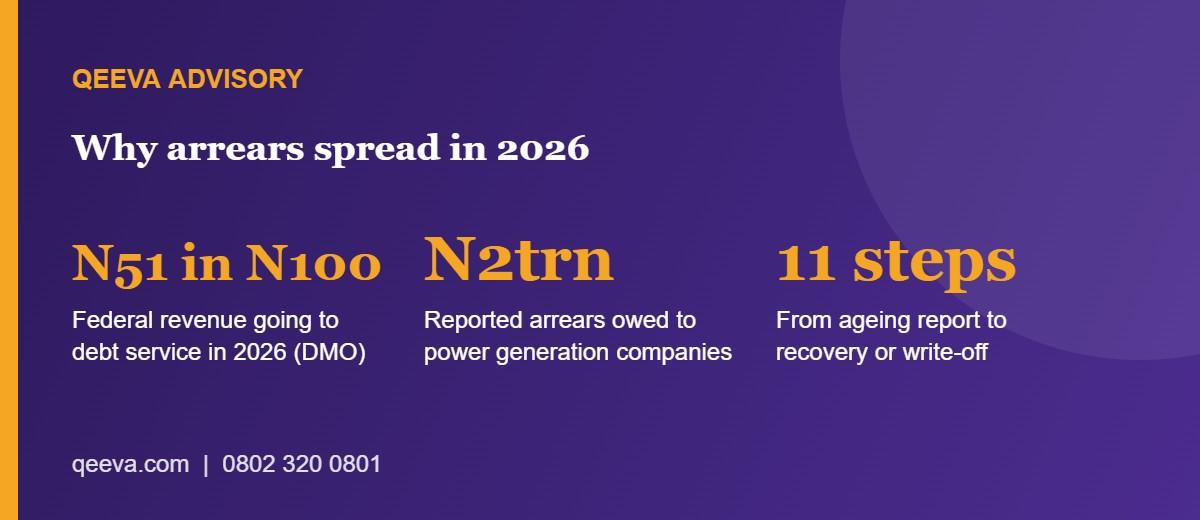
The public sector shows the pattern at scale. The Debt Management Office says debt service will take N51 of every N100 of federal revenue in 2026. Power generation companies are reportedly owed about N2 trillion, according to a Frontier Brief Media summary published on 10 November 2026. When government and utilities run arrears of that size, contractors and their subcontractors feel the squeeze. Your customers may be among them.
This matters for two reasons. First, some of your debtors are genuinely waiting on money owed to them. Second, a customer who blames “the economy” may be choosing to pay others first. Your process must tell the difference.
Step 1: Run an ageing analysis this week
Start with facts, not feelings. Pull a list of every unpaid invoice from your accounting system. Group each balance by how long it has been overdue:
| Ageing band | What to do now |
|---|---|
| Current (not yet due) | Send a statement and confirm the due date |
| 1 to 30 days overdue | Friendly reminder and a phone call |
| 31 to 60 days overdue | Call the payment decision maker today |
| 61 to 90 days overdue | Stop further credit and send a formal demand |
| Over 90 days overdue | Build a recovery plan and test the debtor’s assets |
Add the customer name, contact person, invoice number, invoice date, amount and any notes on disputes or promises. Reconcile the total to your general ledger. If the figures do not agree, fix that first. You cannot chase a debt you cannot prove.
The ageing report tells you where the money is and how stale it has become. As a general rule, the older a debt gets, the harder it is to collect. A debt in the 31 to 60 day band deserves a phone call today. A debt past 90 days needs a formal plan.
Step 2: Prioritise your debtors
You have limited time before the holidays. Spend it where it will return the most cash. Rank each debtor against four questions:
- How much is owed? Large balances come first, but do not ignore a cluster of small ones from the same group.
- How old is it? Older debts carry more risk and need faster action.
- Can they pay? A profitable client with a slow approval process is different from a business in visible distress.
- What is the relationship worth? A long-standing client with future work deserves a softer approach than a one-off buyer who has stopped answering calls.
Sort debtors into three groups. “Call now” covers large, recent balances from good clients. “Escalate” covers older debts where polite reminders have failed. “Watch” covers small or disputed items that need investigation before you act.
Step 3: Verify the debt before you demand it
Many collection efforts collapse because the creditor cannot show exactly what was agreed and delivered. Before you send a demand, assemble a file for each debtor. It should contain:
- The contract or purchase order. Check the price, payment terms, due dates, interest clauses and any dispute resolution clause.
- Invoices. Confirm each one went to the right entity, at the right address, with the correct amount and tax.
- Delivery notes or completion certificates. These prove the goods arrived or the work was done. Signed and dated copies carry the most weight.
- Statements of account. A statement the customer received and did not challenge is strong evidence that the balance is accepted.
- Correspondence. Emails, WhatsApp messages and letters in which the customer acknowledged the debt or promised payment.
Documentation decides cases. The party with clear records holds the advantage in a negotiation, a mediation or a courtroom.
While you build the file, check the debtor’s legal identity. Confirm the exact registered name and registration number with the Corporate Affairs Commission. A demand sent to a trading name or to the wrong company in a group wastes time and may be unenforceable.
Look for genuine disputes too. If a customer has raised a quality complaint or a short delivery, resolve it or credit the disputed portion. Then chase the undisputed balance. This keeps your claim clean and your credibility intact.
Step 4: Talk before you write
For most debtors, the first step is a conversation, not a lawyer’s letter. Call the person who approves payments, not just the person who placed the order. Be direct and polite:
- State the invoice numbers and the total overdue.
- Ask whether anything is blocking payment.
- Agree a specific date and amount.
- Confirm the agreement in writing the same day.
Keep a log of every call and message. A dated record of promises made and broken will help you later if you need to escalate.
Many late payers respond well to this approach. They may have lost the invoice, be waiting on a signatory or need a supplier registration form. Solve the admin problem and the money often follows.
Step 5: Send a formal demand letter
If calls fail, send a written demand. A good demand letter is firm, factual and short. It should:
- Identify the debtor by its correct legal name.
- List the invoices, amounts and due dates.
- Refer to the contract terms, including any agreed interest.
- State a clear deadline for payment, usually seven to fourteen days.
- Explain what you will do if payment does not arrive.
- Provide your bank details and a named contact.
Send it in a way you can prove, such as courier with a signed receipt or email to a known address. Keep copies.
A demand letter also serves a legal purpose. Courts expect a creditor to give the debtor a fair chance to pay before suing. Some contracts require notice or negotiation before any claim. Certain debtors, including some public bodies, may be protected by statutory pre-action notice rules. If your debtor is a government agency or public corporation, take legal advice on notice requirements before you file anything. Missing a required notice can derail a valid claim.
Watch your limitation period too. Contract claims in Nigeria must be brought within a fixed time set by statute. The period can depend on the state and the type of claim. Do not let an old debt drift until it is too late. A written acknowledgement or part payment can affect the position, so record both carefully and ask a lawyer to confirm the deadline for any debt that is several years old.
Step 6: Negotiate and offer an instalment plan
A debtor who wants to pay but cannot clear the full balance deserves a structured option. An instalment plan can turn a frozen debt into regular cash and preserve the relationship.
Put any plan in writing. A sound agreement includes:
- An acknowledgement of the full debt.
- A payment schedule with fixed dates and amounts.
- A first payment on signing, as a sign of good faith.
- A default clause stating that the full balance becomes due if any payment is missed.
- Post-dated cheques or a direct debit mandate where practical.
- Signatures from someone with authority to bind the debtor.
Consider a small discount for prompt settlement before 31 December if your cash need is urgent. Cash in hand this month may be worth more than a larger sum in a dispute next year. Run the numbers before you offer it.
Do not keep supplying a customer on credit while it is behind on a payment plan. Switch to cash on delivery or advance payment until the arrears are cleared.
Step 7: Run background and asset checks before you escalate
Before you spend money on lawyers or court fees, find out whether the debtor can actually pay. A judgment against a company with no assets is a piece of paper.
A background and asset check can tell you:
- Whether the company is still active and who its directors are.
- Whether the business still operates from the address on file.
- Whether it owns property, vehicles or other assets you could enforce against.
- Whether other creditors are pursuing it.
- Whether the directors run related businesses that may have absorbed its trade.
The results shape your strategy. A solvent debtor that is simply stubborn may settle quickly once it sees you are serious. A debtor with few assets may justify a negotiated discount rather than a costly lawsuit. A debtor moving assets to a related company may call for urgent legal action.
Step 8: Try alternative dispute resolution
Court is not the only route. Alternative dispute resolution (ADR) can be faster, cheaper and less damaging to the relationship.
Mediation. A neutral mediator helps both sides reach a deal. In Lagos, the Lagos Multi-Door Courthouse offers mediation and related services for commercial disputes. Mediation works well when the debtor accepts the debt but disputes the amount or timing.
Arbitration. If your contract contains an arbitration clause, you may have to use it before going to court. An arbitral award is binding and can be enforced through the courts. Check your contract early so you follow the right path.
ADR keeps the dispute private. That matters if you want to keep working with the client after the money is settled.
Step 9: Know when to go to court
Litigation is the last rung, not the first. Go to court when the debt is clear, the debtor can pay and other steps have failed.
Lagos offers procedures designed for straightforward debt claims.
The Small Claims Court. Lagos State operates small claims courts for lower-value liquidated money claims. They aim to resolve simple debt cases quickly with simplified procedures. The court applies a maximum claim value set in its practice directions, which have been updated over time. Check the current limit and rules before filing.
The undefended list. For larger liquidated sums, the High Court has a procedure for claims where the creditor believes the debtor has no real defence. If the debtor cannot show a genuine defence, the court can enter judgment without a full trial. This is the reason Step 3 matters so much. Clear contracts, invoices, delivery notes and acknowledged statements make this route far stronger.
A court process will not finish before Christmas. Filing does, however, change the tone of negotiations. Many debtors settle once a claim is served. Speak to a qualified lawyer about which court and procedure fit your claim.
Step 10: Watch for insolvency risk
Some debtors are not slow. They are failing. Warning signs include:
- Repeated broken promises with no part payments.
- Bounced cheques.
- Staff layoffs or a closed office.
- Directors who stop taking calls.
- Other suppliers complaining of the same problem.
- Assets being sold or moved.
If you see these signs, act quickly. Creditors who move early often recover more than those who wait. The Companies and Allied Matters Act 2020 provides insolvency tools, including winding up and administration, and sets rules on how creditors are treated. Insolvency proceedings are serious steps with their own costs and consequences. Take legal advice before threatening or starting them, and do not use a winding-up threat to pressure a debtor over a genuinely disputed debt.
Step 11: Get the tax treatment right
Some debts will not be recovered. When that happens, record them correctly.
In general terms, Nigerian tax law allows a business to deduct a bad debt when it can show the debt was incurred in the course of its business, was previously included in taxable income and has become genuinely irrecoverable. Tax authorities expect evidence of the steps taken to recover it. Your demand letters, call logs, background check reports and legal advice all help support the claim. A general provision for doubtful debts is usually treated differently from a specific debt written off. Any amount you later recover should be brought back into income. PwC’s Nigeria tax summary sets out the general deduction rules.
The Nigeria Tax Act 2025 took effect in 2026 and changed several rules. Confirm the current conditions with a tax adviser before your year-end accounts are finalised. Review VAT as well. If you charged VAT on an invoice that was never paid, ask whether any relief applies.
Your escalation ladder at a glance
Use this sequence for each overdue account. Move up one rung only when the previous step has failed.
- Reconcile and verify. Confirm the balance, legal entity and supporting documents.
- Friendly reminder. Send a statement and a polite email.
- Phone call. Speak to the payment decision maker and agree a date.
- Written follow-up. Confirm promises in writing the same day.
- Stop further credit. Put the account on hold or cash terms.
- Formal demand letter. Set a firm deadline and state the consequences.
- Negotiate. Offer a signed instalment plan or settlement discount.
- Background and asset check. Test whether escalation is worth the cost.
- Lawyer’s letter and ADR. Propose mediation or invoke arbitration if the contract requires it.
- Court action. Use the Small Claims Court or undefended list where suitable.
- Insolvency action or write-off. Pursue a failing debtor through the proper process, or write off the debt with full evidence for tax purposes.
Controls that prevent repeat losses
The best debt recovery work happens before you issue the invoice. Put these controls in place for 2027.
Credit vetting. Before you extend credit to a new customer, check its registration, ownership and trading history. Ask for trade references and speak to them. For large accounts, run a background check on the business and its directors.
Credit limits. Set a maximum balance for each customer based on its size and payment record. Review the limit regularly. Block new orders automatically when a customer exceeds it.
Know your customer (KYC). Keep up-to-date records of each customer’s legal name, registration number, tax identification number, registered address, directors and authorised signatories. Many disputes start with a vague identity.
Clear contracts. Use written terms that state the price, payment period, interest on late payment, dispute process and governing law. Get them signed before work starts.
Proof of delivery. Never release goods or sign off a job without a signed and dated delivery note or completion certificate.
Prompt invoicing. Invoice on delivery, not at month end. Each day of delay pushes back the payment date.
Monthly statements. Send statements every month. Ask customers to flag disagreements within a set period. Silence then becomes useful evidence.
Weekly ageing reviews. Review the ageing report every week. Assign each overdue account to a named person with a target date.
Deposits and security. For large or risky orders, ask for a deposit, a bank guarantee or a personal guarantee from a director.
For more on day-to-day credit control, see our accounts receivable and credit control questions answered.
Act now, not in January
November and December reward businesses that move first. Clients clear their own year-end budgets in these weeks and pay the suppliers who ask clearly and persistently. Start with the ageing report today. Verify your strongest claims. Call your biggest debtors this week. Escalate in steps and keep every record.
Handled well, debt recovery protects your cash and your client relationships at the same time.
Frequently asked questions
What is the first step in debt recovery in Nigeria?
Run an ageing analysis. List every unpaid invoice by how long it is overdue and reconcile the total to your ledger. Then verify each debt with contracts, invoices and delivery notes before you chase it.
Do I need to send a demand letter before going to court?
A demand letter gives the debtor a fair chance to pay and shows the court you acted reasonably. Some contracts and some public bodies require formal notice before a claim. Check your contract and take legal advice if the debtor is a government agency.
Should I offer an instalment plan to a late payer?
Yes, if the debtor accepts the debt and can show a realistic way to pay. Put the plan in writing, ask for a first payment on signing and include a clause that makes the full balance due if any instalment is missed.
Why run a background or asset check before suing?
A judgment is only useful if the debtor can pay. A check shows whether the company is active, who runs it and what assets it holds. That helps you decide between negotiation, ADR and court.
Can I claim tax relief on a bad debt?
In general, a business can deduct a debt that arose from its trade, was included in taxable income and has become genuinely irrecoverable. You need evidence of recovery efforts. Confirm the current rules under the Nigeria Tax Act 2025 with a tax adviser.
How Qeeva Advisory can help
Qeeva Advisory helps Nigerian businesses verify debts, run background and asset checks, structure instalment settlements and recover what they are owed. See our commercial debt recovery service, our complete guide to commercial debt recovery and our business recovery services.
To start on your year-end collections, call 0802 320 0801 or 0807 576 5799, email info@qeeva.com, or visit qeeva.com.
This article provides general information only. It is not legal or tax advice. Speak to a qualified legal practitioner or tax adviser about your specific circumstances.