
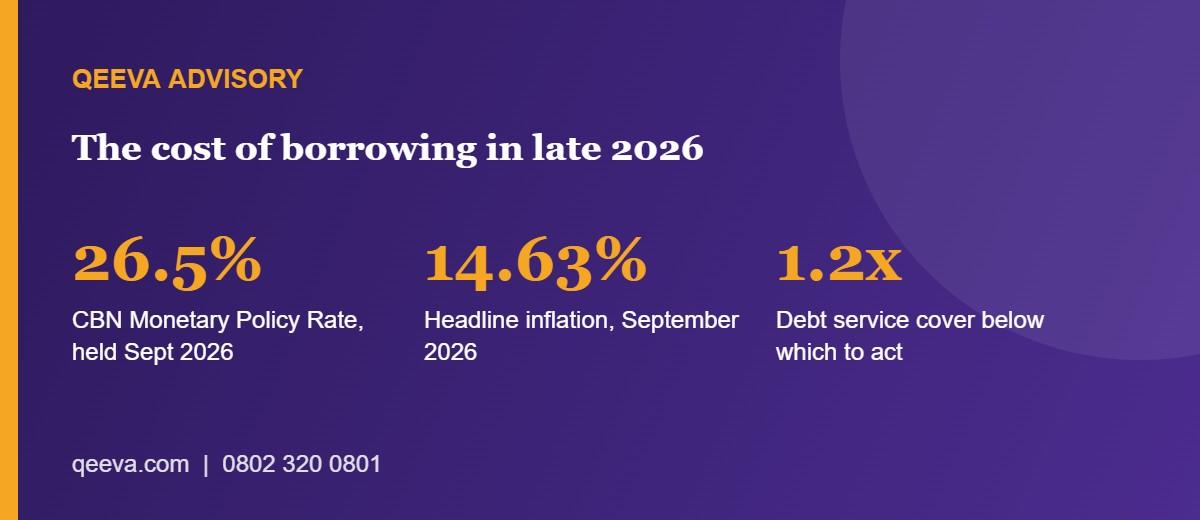
Many Nigerian SMEs borrowed when rates were lower and plans were bolder. Now the Monetary Policy Rate sits at 26.5%, where the Central Bank of Nigeria held it at its September 2026 meeting. Commercial lending rates sit well above that. A facility that looked affordable two years ago can now take most of a company’s operating cash flow just to service.
When repayments start to bite, many owners do the worst thing possible. They go quiet. They miss a payment, ignore the relationship manager’s calls and hope sales will recover before the bank acts. By the time they talk, the account is classified as non-performing, penalty interest is running and the bank’s recovery team is in charge.
Loan restructuring is the alternative. Done early and done well, it turns a debt that is choking the business into one it can carry. This guide explains when to restructure, what options banks will consider, how to build a proposal the credit committee will approve, and the traps to avoid.
Signs you need to restructure now
Do not wait for a missed payment. These are the early signs that your current debt terms no longer fit the business:
- Debt service takes more than half of monthly operating cash flow
- You are using overdraft lines to meet term loan repayments
- You have delayed paying suppliers, staff or taxes to keep the loan current
- Your debt service coverage ratio has fallen below 1.2 times
- A loan covenant, such as a minimum current ratio, has been breached or soon will be
- Sales have fallen or margins have shrunk and you see no quick recovery
If two or more of these apply, start the conversation with your bank this month. Banks have more room to help a performing customer than a defaulting one.
Why banks will listen
Banks do not want to recover loans through the courts. Litigation is slow and expensive, collateral often sells below its book value, and a written-off loan hurts the bank’s own results. A customer who comes early with a credible plan gives the bank a better outcome than enforcement. Most credit committees know this.
Banks also face their own pressures. Regulators expect them to manage their non-performing loan ratios. A well-structured restructuring that keeps a loan performing helps the bank as much as it helps you.
That does not mean the bank will accept any proposal. It means a realistic, well-evidenced plan has a fair chance.
The restructuring options
No single option suits every business. Most deals combine two or three of these.
| Option | What it does | Best for |
|---|---|---|
| Tenor extension | Spreads the remaining principal over more years | Viable business with a short-term cash squeeze |
| Moratorium | Pauses principal, sometimes interest, for a set period | Temporary shock, such as a lost contract or a slow quarter |
| Rate reset | Lowers the interest rate or removes a margin | Strong customer with competing offers from other lenders |
| Repayment reprofiling | Matches repayments to seasonal cash flow | Seasonal businesses, such as agribusiness or school suppliers |
| Conversion | Turns an overdraft into an amortising term loan | Businesses living on a permanent overdraft |
| Partial asset sale | Sells a non-core asset to pay down debt | Businesses with idle property, vehicles or equipment |
| Debt to equity | Lender or new investor takes equity for part of the debt | Larger companies with a clear turnaround plan |
Tenor extension
This is the most common tool. A three-year loan becomes a five-year loan. Each payment shrinks, but total interest rises. It works when the business is fundamentally sound and the problem is timing.
Moratorium
A moratorium buys breathing space. Three to six months is common. Interest usually keeps accruing and is either paid monthly or added to the principal. Use the time to fix the cause of the problem. A moratorium with no recovery plan behind it only delays the same crisis.
Rate reset
Banks will rarely cut rates for a struggling borrower. A rate reset becomes possible when you can show another lender would refinance you, or when you offer better security or a larger share of your banking business.
Repayment reprofiling
Equal monthly instalments do not fit every business. A school supplier earns most of its revenue in three months a year. A farm input dealer peaks around the planting season. Reprofiling sets larger payments in strong months and smaller ones in weak months.
Conversion of overdraft to term loan
Many SMEs run an overdraft that never comes down. The bank treats it as hardcore borrowing, and the business pays high interest with no plan to repay. Converting the hardcore portion into a term loan with fixed repayments gives both sides clarity.
Build a proposal the credit committee will approve
Your relationship manager cannot approve a restructuring alone. They must take a case to a credit committee that has never met you. Your proposal must win that room. A strong proposal has six parts.
1. An honest explanation of what went wrong
State the cause plainly. A major customer delayed payment. Input costs rose faster than prices. A new branch underperformed. Credit committees distrust proposals that blame everything on the economy. They trust owners who show they understand their own business.
2. Up-to-date financial statements
Provide the latest audited accounts and management accounts to the end of last month. If your books are behind, bring them up to date first. A proposal built on old figures will be sent back.
3. A 24-month cash flow forecast
This is the heart of the proposal. Show monthly cash in and cash out, with existing debt service and the proposed new terms. Explain every key assumption, such as sales growth, collection days and price increases. Run a downside case too. If the plan only works when everything goes right, it will not be approved.
4. The specific terms you are asking for
Do not ask the bank to “help”. Ask for a 12-month extension, a four-month principal moratorium and a conversion of N40 million of overdraft into a term loan. Specific requests show you have done the work and make the committee’s job easier.
5. What you are offering in return
Give the bank something. Options include extra security, a personal guarantee, a commitment to route more collections through the bank, quarterly management accounts, or a cap on dividends and director withdrawals until the loan is current.
6. The turnaround actions
Show what you will change inside the business. Cutting costs, closing a loss-making line, chasing debtors harder or selling idle assets all count. The bank needs to see that the restructured loan will be repaid from a healthier business, not from hope.
A worked example
The figures below are illustrative only.
A Lagos packaging company has a N150 million term loan with two years left, plus a N60 million overdraft that has been fully drawn for 18 months. Monthly operating cash flow has fallen to N9 million after a key customer cut orders. Current debt service is N9.8 million a month, more than the business generates.
The company proposes:
- A three-year extension of the term loan
- A four-month moratorium on principal, with interest paid monthly
- Conversion of N45 million of the overdraft into a three-year term loan
- An extra charge over an idle warehouse in Ikorodu as additional security
- Quarterly management accounts to the bank
After the moratorium, combined debt service falls to about N6.5 million a month. That leaves room for working capital and gives a debt service coverage ratio of about 1.4 times. The company also lists the warehouse for sale. Proceeds will go first to reduce the loan.
The proposal shows the bank how it gets repaid, what security it gains and what the company is changing. It is the kind of case a credit committee can approve.
Negotiate with your eyes open
Read every line of the restructuring offer. Watch for these points:
- Fees. Restructuring fees, legal fees and valuation fees can be large. Ask for them in writing and negotiate.
- Capitalised interest. Interest added to principal increases the total you repay. Know the final figure.
- Penalty interest. Make sure past default interest is waived or capped, not carried into the new loan.
- Cross-default clauses. A default on one facility may trigger default on all. Understand the links.
- Personal guarantees. A guarantee puts your own assets at risk. Limit the amount and the period where possible.
- Covenants. New covenants must be ones you can meet. A covenant you will breach in month three is a trap.
Check the bank’s charges and interest on your existing facilities before you sign. Restructuring is a good moment to correct past overcharges, and a forensic review of your statements may reduce what you owe.
What a restructuring does to your credit record
A restructured loan is usually reported to the credit bureaus as restructured. That is far better than a default, which follows the company and its directors for years and blocks new credit. Keep paying on the new terms and your record improves over time. Fall behind on a restructured loan and the bank will have little patience left.
When restructuring is not enough
Some businesses cannot be saved by better loan terms alone. If the forecast still shows a deficit after a realistic restructuring, deeper action is needed. Options include bringing in a new equity investor, selling part of the business, merging with a stronger competitor, or using a formal process under the Companies and Allied Matters Act 2020, such as a company voluntary arrangement or administration. Take professional advice before the cash runs out, not after.
Common mistakes to avoid
Waiting until you default. The best terms go to customers who ask early.
Asking without a plan. A request with no forecast or turnaround actions will be refused or sent back.
Over-optimistic forecasts. Banks see hundreds of hockey-stick projections. Use realistic assumptions and show a downside case.
Ignoring other lenders. If you have facilities with several banks, a deal with one may be undone by enforcement from another. Talk to all of them.
Diverting cash. Moving collections to another bank or paying out dividends while asking for relief destroys trust.
Signing without reading. Fees, guarantees and covenants in the new offer letter matter as much as the headline terms.
Frequently asked questions
When should an SME approach its bank about restructuring?
As soon as debt service starts to squeeze operating cash flow, ideally before any payment is missed. Banks have more flexibility with performing customers than with accounts already classified as non-performing.
What documents does a bank need for a loan restructuring?
Expect to provide recent audited and management accounts, a 24-month cash flow forecast, a clear explanation of what went wrong, the specific terms requested, the security on offer and the turnaround actions you will take.
Will restructuring hurt my credit rating?
The loan will usually be reported as restructured, which is much better than a default. Keeping up with the new terms rebuilds your record over time.
Can I get a lower interest rate when restructuring?
Sometimes, but it is harder than getting a longer tenor or a moratorium. A rate cut is more likely if you can show another lender would refinance you or you offer better security or more banking business.
What if the bank refuses?
Ask what would change their decision and revise the proposal. If talks fail, consider refinancing with another lender, bringing in equity or selling assets. Take advice early on formal options under CAMA 2020 if the business cannot meet its debts.
How Qeeva Advisory can help
Qeeva Advisory prepares restructuring proposals, builds cash flow forecasts that credit committees trust, negotiates with lenders and finds alternative funding through debt and equity placement. See our commercial debt recovery and debt and equity placement service, our business recovery services and our SME financial stability scorecard.
To review your loan position, call 0802 320 0801 or 0807 576 5799, email info@qeeva.com, or visit qeeva.com.
This article is general information based on public data available on 11 November 2026. The worked example is illustrative. It is not legal or financial advice. Take professional advice on your own facilities.