
A bad hire costs a Nigerian business far more than a salary. A finance officer with a fake degree signs off on payments. A driver with an undisclosed history disappears with a truck of goods. A sales manager who claimed experience he never had loses key accounts. Each of these cases starts the same way: an employer who took a CV at face value.
Pre-employment background checks reduce that risk. They confirm that candidates are who they say they are, that their qualifications are real, and that their work history holds up. In Nigeria, where certificate forgery, identity fraud and fabricated references remain common, checks are a basic control for any role that handles money, data, stock or customers.
But checks must also respect the law. The Nigeria Data Protection Act 2023 governs how employers collect and use candidates’ personal data. This guide explains what employers can verify, how to do it lawfully, and how to build a screening process that fits your budget and your roles.
Why background checks matter in Nigeria
Certificate fraud. Fake WAEC results, forged degree certificates and false professional qualifications circulate widely. Universities and examination bodies regularly report forged documents presented for employment and admission.
Identity fraud. Candidates may use another person’s name, documents or bank details. With National Identification Numbers now linked to bank accounts and SIM cards, identity verification has become easier and more important.
Undisclosed history. Candidates may hide dismissals for fraud, previous disputes or gaps in employment.
Guarantor culture. Many Nigerian employers rely on guarantors as a safeguard. A guarantor letter with an unverified name and phone number offers little protection.
Regulatory expectations. Banks, insurers, pension operators and capital market firms face fit and proper requirements for key staff. Other sectors increasingly expect similar diligence for sensitive roles.
What employers can check
| Check | What it confirms | How it is usually done |
|---|---|---|
| Identity | The candidate is who they claim to be | Verify NIN and government ID through authorised verification services |
| Education | Certificates are genuine | Confirm with the issuing school, university or examination body |
| NYSC | Service completed or exemption genuine | Verify the discharge or exemption certificate |
| Professional qualifications | Membership is real and current | Check the professional body’s register, such as ICAN, CITN or NBA |
| Employment history | Dates, roles and reasons for leaving | Contact previous employers’ HR departments in writing |
| References | Conduct and performance | Structured calls with referees, ideally former line managers |
| Guarantors | Guarantor exists and accepts responsibility | Visit or call, verify identity and address |
| Address | The candidate lives where they say | Physical verification or utility bills |
| Criminal record | Relevant convictions | Police character certificate where lawful and relevant to the role |
| Credit history | Financial responsibility for finance roles | Only where lawful, with explicit consent and a clear purpose |
Not every role needs every check. Match the depth of screening to the risk of the role.
Staying within the Nigeria Data Protection Act 2023
Background checks involve collecting and processing personal data, some of it sensitive. The Nigeria Data Protection Act 2023 sets out how employers must handle it.
Have a lawful basis
Employers need a lawful basis for each check. Consent is common, but legitimate interests or legal obligation may also apply depending on the check and the role. For sensitive personal data, stricter conditions apply. Explain to the candidate what you will check, why, and how long you will keep the results.
Collect only what you need
Collect information that is relevant to the role. A receptionist does not need a credit check. A cashier may need more scrutiny than a gardener. Document why each check is necessary for each role category.
Tell candidates what you are doing
Give candidates a written notice explaining the checks, who will carry them out, how data will be stored, and their rights to access and correct their data. Obtain signed consent where consent is the basis.
Protect the data
Store background check results securely, restrict access to HR staff who need them, and delete them when no longer required. Unsuccessful candidates’ data should not be kept indefinitely.
Control your service providers
If you use a background screening company, it acts as your data processor. Sign a contract that binds it to data protection obligations, and confirm how it collects and secures information.
Penalties under the Act reach the higher of ₦10 million or 2% of annual gross revenue for data controllers or processors of major importance, and the higher of ₦2 million or 2% for others. Careless screening can create legal exposure as well as preventing it.
Building a screening process
1. Classify roles by risk
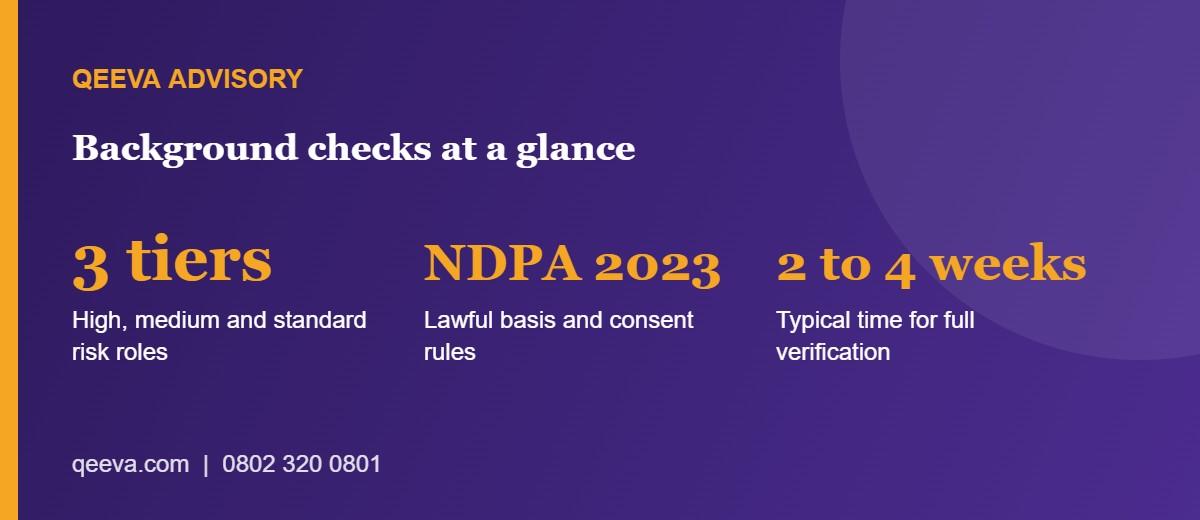
Group roles into tiers:
- Tier 1, high risk: finance, procurement, treasury, IT administrators, senior management, roles handling cash or sensitive data.
- Tier 2, medium risk: sales staff with customer accounts, storekeepers, drivers carrying goods, HR staff.
- Tier 3, standard: other roles.
2. Set the checks for each tier
Tier 1 might require identity, education, professional qualifications, employment history, references, guarantor verification, address verification and a police character certificate. Tier 3 might require identity, highest qualification and one reference.
3. Build checks into the hiring timeline
Run checks after the conditional offer and before the start date. Make offers conditional on satisfactory checks, and say so in the offer letter.
4. Assess results fairly
Not every discrepancy means rejection. A candidate who rounded employment dates by a month is different from one who invented a degree. Set clear criteria and allow candidates to explain discrepancies before you decide.
5. Record decisions
Keep a record of checks performed, results and decisions. This protects the company if a decision is challenged.
A worked example
A Lagos logistics company hired a finance manager whose CV listed a first-class degree, ICAN membership and eight years at two well-known firms. The company skipped checks because the candidate interviewed well and the role was urgent.
Fourteen months later, an audit found ₦38 million in unexplained payments to a supplier linked to the finance manager. During the investigation, the company finally checked the candidate’s background. The university had no record of the degree. ICAN confirmed he was not a member. One previous employer said he had been dismissed after a fraud investigation.
A full background check before hiring would have cost a small fraction of the loss. After the case, the company introduced tiered screening and made all finance and procurement offers conditional on completed checks.
Details have been changed to protect identities.
Rechecking existing staff
Screening does not end at hiring. Consider periodic checks when:
- An employee moves into a high-risk role.
- Regulatory requirements change.
- Concerns arise about an employee’s conduct.
- The company discovers gaps in past screening.
Rechecks need the same care over lawful basis, transparency and proportionality as pre-employment checks.
Common mistakes
- Relying on photocopies of certificates without contacting the issuing institution.
- Accepting references from friends instead of former managers.
- Treating guarantor forms as a formality.
- Running intrusive checks on low-risk roles.
- Starting new staff before checks are complete.
- Keeping candidates’ data indefinitely.
- Using screening providers without data protection contracts.
Verifying guarantors properly
Guarantors remain common in Nigerian hiring, especially for drivers, cashiers, storekeepers and domestic staff. A guarantor agrees to vouch for the employee and, in some forms, to compensate the employer for losses the employee causes. The protection is only as good as the verification.
A proper guarantor check confirms:
- Identity. The guarantor’s NIN or government ID, matched to the name on the form.
- Address. A physical visit or reliable proof of address.
- Employment or standing. Many employers require guarantors to be civil servants above a certain grade, business owners or professionals. Confirm the claim.
- Relationship and consent. The guarantor knows the candidate and understands the obligation.
- Signature. The guarantor signs in the presence of a witness, or the signature is confirmed by phone or visit.
Keep guarantor forms with the employee file and review them when staff are promoted into higher-risk roles. A guarantor who has moved, retired or died provides no protection.
Background checks for senior and executive hires
Senior hires deserve deeper screening because the damage they can cause is greater. For directors, chief financial officers and heads of key functions, consider:
- Verification of every qualification and directorship claimed.
- CAC searches on companies the candidate has directed or owned.
- Searches for litigation and regulatory sanctions.
- Media and reputational searches.
- In-depth references from former board members, auditors or regulators where possible.
- Checks for conflicts of interest with suppliers, customers or competitors.
In regulated sectors, these checks also support fit and proper submissions to regulators such as the CBN, SEC, NAICOM and PenCom.
Choosing a screening provider
If you outsource background checks, assess providers carefully:
- Methods. Do they verify directly with issuing institutions, or rely on documents supplied by the candidate?
- Turnaround. What timelines do they commit to for each check?
- Data protection. Will they sign a data processing agreement and explain how they secure data?
- Reporting. Are reports clear, with sources and dates for each verification?
- Coverage. Can they verify institutions and addresses across Nigeria and abroad?
- Cost. Is pricing per check or per candidate, and what is included?
A cheap provider that rubber-stamps documents gives false comfort.
Background checks and fairness
Screening should be consistent and non-discriminatory. Apply the same checks to all candidates for the same role. Do not use checks to screen out candidates for reasons unrelated to the job, such as ethnicity, religion or state of origin. Where a check reveals adverse information, consider its relevance to the role, how long ago it occurred and the candidate’s explanation. A transparent, consistent process protects both the employer and the candidate.
Cost versus loss
A full Tier 1 background check typically costs far less than one month of the salary for the role being filled. Compare that with the cost of a single fraud, a wrongful hire in a regulated position, or a replacement recruitment after a failed appointment. For high-risk roles, screening is one of the cheapest controls a company can buy.
Frequently asked questions
Are background checks legal in Nigeria?
Yes, when carried out lawfully. Employers must have a lawful basis under the Nigeria Data Protection Act 2023, collect only relevant information, inform candidates and protect the data.
How do employers verify certificates in Nigeria?
By contacting the issuing institution directly, such as the university registry, WAEC or NECO verification services, NYSC, or the relevant professional body.
Should every new employee undergo the same checks?
No. Match checks to the risk of the role. Finance, procurement, IT and senior roles warrant deeper screening than standard roles.
How long do background checks take?
Identity and qualification checks can take a few days. Employment history and university verification can take two to four weeks, depending on how quickly institutions respond.
Can an employer withdraw an offer after a failed background check?
Yes, if the offer was expressly conditional on satisfactory checks and the decision follows a fair process. State the condition in the offer letter.
Should employers verify guarantors?
Yes. Confirm the guarantor’s identity, address, standing and consent. An unverified guarantor form offers little protection.
How Qeeva Advisory can help
Qeeva Advisory Limited carries out pre-employment background checks for Nigerian employers, including identity, education, professional qualification, employment history, reference, guarantor and address verification. We design tiered screening policies that comply with the Nigeria Data Protection Act 2023. See our executive search and talent management services and payroll management and HR advisory.
Screen your next hire: call 0802 320 0801 or 0807 576 5799, email info@qeeva.com, or visit www.qeeva.com.
This article is general information, not legal advice.