
Ask staff in many Nigerian companies how salaries are set and you will hear the same answers. “It depends on who negotiated well.” “The MD decides.” “New hires earn more than people who have been here for years.” Pay has grown case by case, through counter-offers, favours and historical accidents. The result is a structure nobody can explain and few people trust.
Salary grading fixes this. It groups jobs into grades based on their value to the organisation, and attaches a pay range to each grade. Combined with job evaluation, it gives employers a defensible, consistent way to pay people, control payroll costs and compete for talent.
This guide explains how job evaluation and salary grading work, how to build a structure for a Nigerian company, and how to implement it without causing a staff revolt.
Why pay structures break down
Without a structure, pay drifts in predictable ways:
- Pay compression. New hires join on market rates while long-serving staff stay on old rates, so juniors earn almost as much as their supervisors.
- Inconsistency. Two people doing similar jobs earn very different salaries because they joined at different times or negotiated differently.
- Favouritism, real or perceived. When nobody understands how pay is set, staff assume the worst.
- Uncontrolled costs. Every hire and counter-offer becomes a one-off negotiation, and payroll grows faster than revenue.
- Attrition of good people. High performers leave when they discover peers earn more for less.
Inflation makes these problems worse. With headline inflation still at 14.63% in September 2026 and the new PAYE rules changing take-home pay since January, staff are comparing payslips more closely than ever.
Job evaluation: valuing jobs, not people
Job evaluation assesses the relative value of jobs within an organisation. It looks at the job, not the person doing it. A finance manager role is evaluated on its responsibilities, not on how well the current finance manager performs.
Common methods
| Method | How it works | Suits |
|---|---|---|
| Ranking | Jobs are ranked from highest to lowest value as a whole | Small companies with few roles |
| Classification | Jobs are matched to predefined grade descriptions | Public sector and large organisations with standard roles |
| Point-factor | Jobs are scored against weighted factors such as knowledge, problem-solving, accountability and working conditions | Mid-sized and large companies wanting a defensible system |
| Market pricing | Jobs are priced based on market salary data, then grouped | Companies competing for scarce skills |
Most mid-sized Nigerian companies benefit from a point-factor approach, adjusted with market data for hard-to-fill roles.
A simple point-factor model
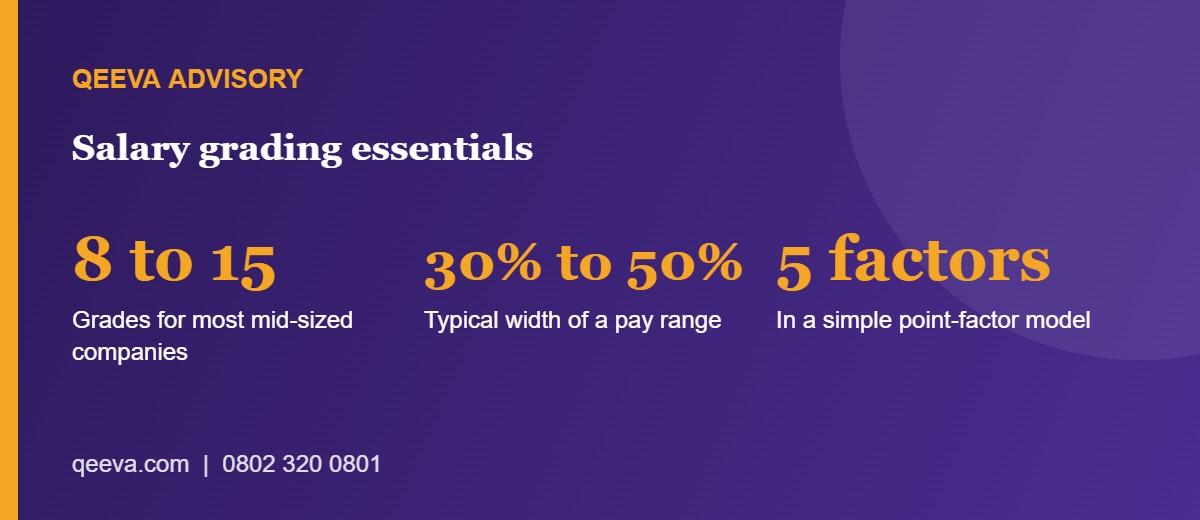
A practical model might use five factors:
- Knowledge and qualifications required for the role.
- Problem-solving and decision-making complexity.
- Accountability for results, resources and people.
- Impact on the organisation’s performance.
- Working conditions and physical demands.
Each factor has levels, and each level carries points. Weights reflect what the organisation values. A trading company might weight impact on revenue heavily. A manufacturing company might give more weight to technical knowledge and working conditions.
Building the grading structure
1. Update job descriptions
Job evaluation is only as good as the job descriptions behind it. Many Nigerian companies have outdated or missing descriptions. Interview managers and job holders, and document the purpose, responsibilities, reporting lines, qualifications and key performance indicators for every role.
2. Evaluate every job
A small evaluation panel, usually including HR, senior managers and an external facilitator, scores each job. Consistency matters more than precision. Benchmark jobs, which are well understood and common in the market, help calibrate the scoring.
3. Group jobs into grades
Plot jobs by points and look for natural breaks. Most mid-sized companies need between eight and fifteen grades. Too few grades lump very different jobs together. Too many create artificial distinctions and constant regrading requests.
4. Price the grades
Use salary survey data, recruitment experience and published market information to set pay ranges for each grade. Each range has:
- Minimum: the entry point for someone new to the grade.
- Midpoint: the market rate for a fully competent job holder.
- Maximum: the ceiling for the grade.
Range widths of 30% to 50% from minimum to maximum are common, with wider ranges for senior grades.
5. Decide the market position
Decide whether to pay at the market median, above it for critical roles, or below it with stronger benefits or career development. The decision should match strategy and affordability.
6. Place employees in the structure
Map each employee to the grade of their job and compare their pay with the range. Most will fall within it. Some will fall below the minimum, and some above the maximum.
Implementation: handling the hard cases
Staff below the minimum
Bring them to the minimum, either immediately or in phases over 12 to 24 months depending on cost. Leaving people below the minimum undermines the credibility of the new structure.
Staff above the maximum
These people are often called “red-circled”. Do not cut their pay. Freeze increases or give lump-sum payments instead of base increases until the range catches up through future adjustments.
Communication
Explain the purpose of the exercise, the method, and how it affects each employee. Hold briefings, provide written explanations, and give each employee a personal letter showing their grade and range. Train managers to answer questions. Set up an appeals process for employees who believe their job has been graded wrongly.
Policy
Write a pay policy covering how new hires are placed in ranges, how increases are awarded, how promotions work, how jobs are regraded, and who approves exceptions.
Linking grades to performance and progression
A grading structure is the foundation for performance-based pay. Employees move through their range based on performance and competence. Top performers move faster towards the midpoint and beyond. Promotion to a higher grade happens when someone takes on a bigger job, not simply through length of service.
Clear career paths, showing what employees need to progress to the next grade, help retain ambitious staff.
A worked example
A Lagos-based services company with 140 staff had grown through acquisitions. It had three different pay systems inherited from the companies it bought, and 23 job titles that described essentially the same five roles.
The company updated job descriptions, used a point-factor evaluation to create a structure of eleven grades, and priced them using market data. The analysis found 31 employees below their grade minimum, most of them long-serving staff, and 6 above their maximum.
The company raised the 31 employees to the minimum over 12 months at a cost of 4.2% of payroll, red-circled the 6 overpaid staff, and introduced a pay policy with clear rules for new hires and increases. Staff turnover fell in the following year, and the time spent negotiating individual salaries dropped sharply.
Figures are illustrative.
Common mistakes
- Evaluating the person instead of the job.
- Using outdated job descriptions.
- Creating too many grades.
- Pricing grades without reliable market data.
- Cutting the pay of staff above the maximum.
- Implementing without communication and appeals.
- Allowing managers to bypass the structure for favoured hires.
Where to find market pay data in Nigeria
Reliable salary data is harder to find in Nigeria than in more mature markets, but several sources help:
- Salary surveys run by consulting and HR firms, often by sector.
- Industry associations and employers’ groups that share pay data among members.
- Recruitment experience, including offers made, offers rejected and candidates’ expectations.
- Exit interviews, which reveal what competitors are offering.
- Published pay scales in the public sector and some regulated industries, useful as reference points.
Use more than one source, adjust for company size and location, and age the data for inflation if it is more than a few months old. A survey from early 2025 understates pay levels in late 2026.
Allowances and benefits within the structure
Many Nigerian pay packages split pay into basic salary and allowances for housing, transport, meals, utilities and leave. A grading structure should define the full package for each grade, not just basic salary.
Decide:
- Which allowances apply to which grades.
- Whether allowances are fixed amounts or percentages of basic.
- How benefits in kind, such as cars and housing, are allocated by grade.
- How pension contributions, calculated on basic, housing and transport under the Pension Reform Act 2014, will be affected.
Under the Nigeria Tax Act 2025, most allowances are taxable as employment income, so splitting pay into many allowances rarely saves tax. Simplifying the package often reduces errors and makes pay easier to understand.
Paying for scarce skills
Some roles command market premiums that a point-factor system alone will not capture. Software engineers, data analysts, cybersecurity specialists, experienced auditors and petroleum engineers are examples where demand outstrips supply in Nigeria, and where emigration has thinned the pool.
Handle these through a documented market premium, a supplement paid on top of the grade range for specified roles. Review premiums every year and remove them if the market cools. This keeps the core structure intact while allowing the company to compete for critical talent.
Pay equity checks
Once the structure is in place, check for unexplained pay gaps between groups doing work of equal value. Compare pay by gender, department, location and length of service within each grade. Gaps that cannot be explained by performance, experience or market premiums should be addressed. Fair pay improves retention and reputation, and many multinational clients and investors now ask about pay equity in due diligence.
Governance of pay decisions
A structure fails if managers can ignore it. Set clear approval rules:
- New hire offers within the range need line manager and HR approval.
- Offers above the midpoint need senior management approval.
- Offers above the maximum need managing director or remuneration committee approval, with written justification.
- Annual increases follow a budget and a performance-based matrix.
Report exceptions to the board or remuneration committee every year.
Frequently asked questions
What is salary grading?
A system that groups jobs of similar value into grades, each with a defined pay range, so that pay is consistent and defensible across the organisation.
What is job evaluation?
A structured process for assessing the relative value of jobs within an organisation, based on factors such as knowledge, responsibility and impact, rather than on the individuals doing the jobs.
How many grades should a company have?
Most mid-sized companies use between eight and fifteen grades, depending on size, complexity and the range of roles.
What happens to employees paid above their grade maximum?
Their pay is usually protected, but base increases are frozen or replaced by lump-sum payments until the range catches up.
How often should a salary structure be reviewed?
Review pay ranges against the market every year, and re-evaluate jobs when roles change significantly or the organisation restructures.
How should companies pay for scarce skills within a grading structure?
Use a documented market premium for specified roles, paid on top of the grade range and reviewed annually, rather than distorting the grade structure itself.
How Qeeva Advisory can help
Qeeva Advisory Limited designs salary grading structures for Nigerian organisations. We update job descriptions, facilitate job evaluation, benchmark pay against the market, model implementation costs and support communication with staff. See our payroll management and HR advisory services and performance management and reporting service.
Build a fair pay structure: call 0802 320 0801 or 0807 576 5799, email info@qeeva.com, or visit www.qeeva.com.
This article is general information, not legal or HR advice for your specific circumstances.