
Nigerian businesses that need long-term finance often look beyond commercial banks. Development finance institutions such as the Bank of Industry, the Development Bank of Nigeria through its partner banks, and NEXIM Bank for exporters offer longer tenors, and sometimes lower rates, than standard bank loans. In November 2026, Afreximbank and Nigerian development finance institutions signed arrangements worth $118 million for the creative economy alone.
Yet many applications fail. Loan officers report the same problems again and again: business plans that read like marketing brochures, financial projections that do not hang together, missing documents, and applicants who cannot explain how the loan will be repaid.
A bankable business plan is different from a pitch to equity investors. Lenders do not share in the upside. They care about one thing above all: will the business generate enough cash to repay the loan, with interest, on time, even if things go wrong? This guide explains what a bankable plan contains, how lenders assess it, and how to prepare an application that gets approved.
Equity investors and lenders read plans differently
| Equity investors | Lenders |
|---|---|
| Focus on growth and potential returns | Focus on repayment capacity and downside risk |
| Accept losses in early years | Want positive cash flow to cover debt service |
| Value the size of the opportunity | Value predictability of cash flows |
| Take ownership and board seats | Take security, covenants and guarantees |
| Look for a large exit | Look for steady repayment over the tenor |
A plan written for a venture capital fund will often fail with a development bank, and vice versa. Write for your audience.
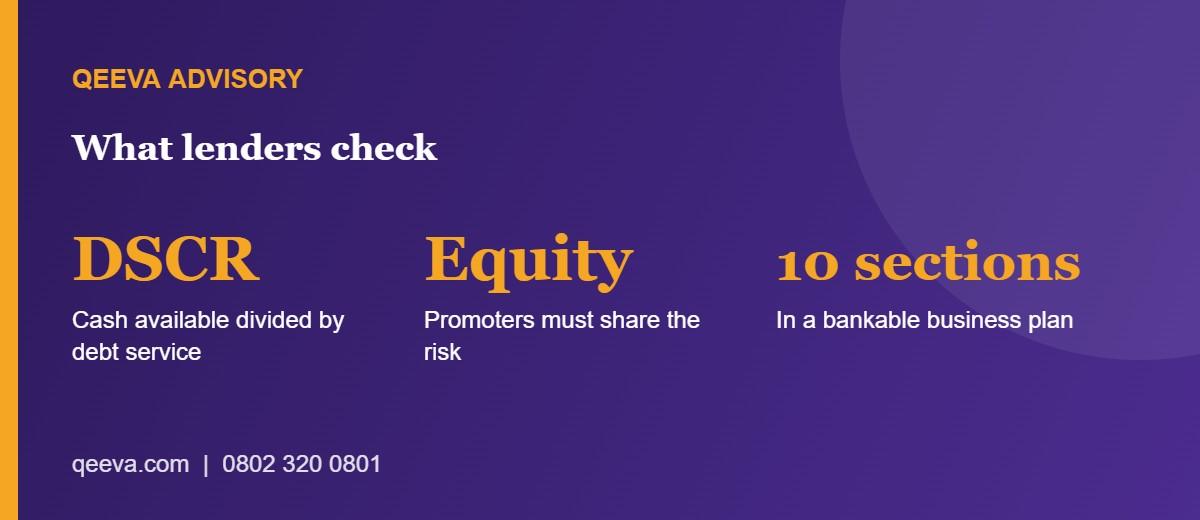
What lenders check
Repayment capacity
The central test is the debt service coverage ratio, cash available for debt service divided by principal and interest due. Lenders typically want comfortable cover above 1.0 times in every year of the loan, with a margin for error. A business that covers its repayments only in the best case will not be approved.
Equity contribution
Lenders expect promoters to put their own money at risk. Many development finance programmes require the applicant to fund a meaningful share of the project cost from equity, often a fifth or more depending on the programme and the risk. Equity can include cash, assets contributed to the project, or retained earnings.
Security
Lenders take security over project assets, other assets of the business, and sometimes personal guarantees from promoters. Some programmes accept credit guarantees from schemes designed to support small businesses with limited collateral.
Management capability
Lenders assess whether the team can execute the plan. They look at the promoters’ track record, relevant experience, and the depth of management.
Market and technical feasibility
For new projects, lenders want evidence that the market exists, that the technology works, and that the project can be delivered on time and within budget.
Compliance
Lenders check that the business is properly registered, tax compliant, and meets environmental, social and sector licensing requirements.
The structure of a bankable business plan
1. Executive summary
Two pages at most. State the business, the project, the amount requested, the use of funds, the proposed tenor and moratorium, the equity contribution, the security offered and the key financial ratios. Many loan officers decide whether to read further based on this page.
2. Company background
Legal status, ownership, history, current operations and financial performance. Include CAC details and a summary of audited results for the last three years.
3. The project
What the loan will finance, why it is needed, and how it fits the business strategy. Describe the location, capacity, technology, suppliers and implementation timeline.
4. Market analysis
Market size and growth, target customers, competitors, pricing and your competitive advantage. Use credible sources and evidence such as offtake agreements, purchase orders, letters of intent and distributor contracts. Evidence of demand carries more weight than market statistics.
5. Operations
Production or service process, capacity utilisation assumptions, raw material sources, staffing and quality control. For manufacturing projects, show how you will manage power, which remains a major cost and risk in Nigeria.
6. Management and organisation
Organisation chart, key people, their experience, and any gaps you plan to fill.
7. Financial projections
Five to seven years of projected income statements, balance sheets and cash flow statements, consistent with each other. Show assumptions clearly, including sales volumes, prices, costs, exchange rates, inflation, interest rates and tax under the Nigeria Tax Act 2025.
8. Financing plan
Total project cost, sources of funds including equity and the loan, the repayment schedule, and the security offered.
9. Risk analysis
Key risks and how you will manage them. Include sensitivity analysis showing the effect of lower sales, higher costs, a weaker naira and delays.
10. Appendices
Registration documents, audited accounts, management accounts, tax clearance, quotations for equipment, offtake agreements, licences, title documents for security, and CVs of key management.
Building projections lenders trust
Most rejections trace back to the financial model. Avoid these traps:
- Hockey-stick sales. Sales that triple in year two with no supporting evidence. Base growth on capacity, contracts and realistic market share.
- Ignored working capital. Growth ties up cash in stock and receivables. A model that shows profit but no cash need is wrong.
- Optimistic exchange rates. If equipment or raw materials are imported, model a weaker naira scenario.
- Missing costs. Generator fuel, maintenance, insurance, licence renewals and statutory payroll costs are often left out.
- No moratorium logic. If you request a moratorium on principal repayments, show why the project needs it and when cash flow starts.
- Inconsistent statements. The balance sheet must balance, and cash in the cash flow statement must match the balance sheet.
Lenders run their own sensitivity tests. Do it first, and show the results.
A worked example
A Kano agro-processor applied for ₦600 million to install a new processing line. Its first application to a development bank was declined. The plan projected sales growing 80% in the second year, assumed full capacity from month three, used a single exchange rate for imported equipment, and showed a debt service coverage ratio of 1.1 times in the base case.
The company revised its plan. It secured offtake agreements with two food manufacturers covering 60% of the new capacity, phased capacity utilisation over 18 months, increased its equity contribution by injecting retained earnings, and modelled equipment costs at a weaker naira rate. The revised base case showed coverage of 1.6 times, and the downside case stayed above 1.2 times.
The second application was approved, with a moratorium aligned to the installation period.
Figures are illustrative.
Documents to prepare early
Collect these before you approach a lender:
- CAC certificate, status report and memorandum and articles.
- Audited financial statements for the last three years.
- Current management accounts.
- Tax clearance certificates and evidence of filed returns.
- Bank statements for the last 12 months.
- Board resolution authorising the borrowing.
- Equipment quotations and project cost breakdown.
- Offtake agreements or letters of intent.
- Title documents and valuation reports for proposed security.
- Relevant permits, licences and environmental approvals.
- CVs of directors and key managers.
Missing documents are the most common cause of delay.
Common mistakes
- Writing a marketing document instead of a credit proposal.
- Presenting projections without stating assumptions.
- Ignoring downside scenarios.
- Underestimating working capital.
- Offering no equity contribution.
- Applying with unaudited accounts or outstanding tax filings.
- Approaching several lenders with different numbers.
Choosing the right lender
Different lenders suit different needs. Before you apply, match your project to the lender’s mandate:
- Bank of Industry focuses on manufacturing, agro-processing, creative industries and other sectors that support industrialisation and jobs.
- Development Bank of Nigeria provides wholesale funding to micro, small and medium enterprises through participating banks and microfinance banks, so you apply through those institutions.
- NEXIM Bank supports exporters and businesses in the export value chain.
- Commercial banks offer working capital and shorter-term facilities, sometimes on-lending development funds.
- Regional and international institutions such as Afreximbank usually work through Nigerian banks or fund larger projects directly.
Read each programme’s eligibility criteria, sector focus and documentation requirements. Applying to the wrong programme wastes months.
Presenting to the credit committee
Many lenders invite applicants to present their proposal. Prepare as carefully as for the written plan:
- Open with the request: amount, purpose, tenor, security and repayment source.
- Explain the business and the project in plain terms.
- Walk through the key assumptions and the evidence behind them.
- Show the base case and downside case debt service coverage.
- Address the main risks before the committee raises them.
- Bring the people who will run the project.
Answer questions directly. If you do not know an answer, say so and follow up in writing. Credit committees value honesty more than polish.
After approval: meeting the conditions
Approval usually comes with conditions precedent, such as perfecting security, injecting equity, obtaining permits or opening a designated account. Meet them quickly, because disbursement waits on them. After disbursement, lenders require regular reporting, including management accounts, audited statements, covenant compliance certificates and project progress reports. A borrower who reports on time and flags problems early builds a relationship that makes the next loan easier.
Working capital is part of the project
Many applicants finance equipment but forget the cash needed to run it. A new production line needs raw materials, packaging, staff and power before the first sale is collected. Include a realistic working capital requirement in the project cost, based on stock days, credit terms to customers and supplier terms. Lenders are more comfortable funding a project that will not stall for lack of operating cash.
Timeline to expect
From first contact to disbursement, development finance loans often take three to six months, and longer for large projects. Factor this into your project schedule, and avoid committing to equipment orders or leases before funding is secured.
Frequently asked questions
What is a bankable business plan?
A business plan prepared for lenders that shows clearly how the business will generate enough cash to repay the loan with interest, supported by credible assumptions, financial projections, security and evidence of demand.
What is the debt service coverage ratio?
Cash available for debt service divided by the principal and interest due in the period. Lenders use it to assess whether a business can meet its repayments, and want comfortable cover above 1.0 times.
How much equity do lenders expect from promoters?
It varies by programme and risk, but many development finance lenders expect promoters to fund a meaningful share of project cost, often a fifth or more, from their own resources.
Which development finance institutions lend to Nigerian businesses?
They include the Bank of Industry, the Development Bank of Nigeria through partner banks, NEXIM Bank for exporters, and regional and international institutions such as Afreximbank, often working with Nigerian banks.
Why are development finance loan applications rejected?
Common reasons include weak repayment capacity, unrealistic projections, insufficient equity, inadequate security, missing documents and tax or regulatory non-compliance.
Which development finance lender should a Nigerian business approach?
Match the project to the lender’s mandate: Bank of Industry for manufacturing and agro-processing, the Development Bank of Nigeria through partner banks for MSMEs, and NEXIM Bank for exporters.
How Qeeva Advisory can help
Qeeva Advisory Limited prepares bankable business plans and financial models for Nigerian businesses seeking loans from development finance institutions and commercial banks. Our plans have supported debt and equity raises across manufacturing, agro-processing, services and real estate. See our business plan service and debt and equity placement service.
Prepare a plan lenders will approve: call 0802 320 0801 or 0807 576 5799, email info@qeeva.com, or visit www.qeeva.com.
This article is general information, not financial advice.