
The discount rate is the most powerful number in any business valuation. Move it two percentage points and a Nigerian company’s value can swing by hundreds of millions of naira. Yet many valuations we review use a rate copied from an old report or picked because it “feels right”.
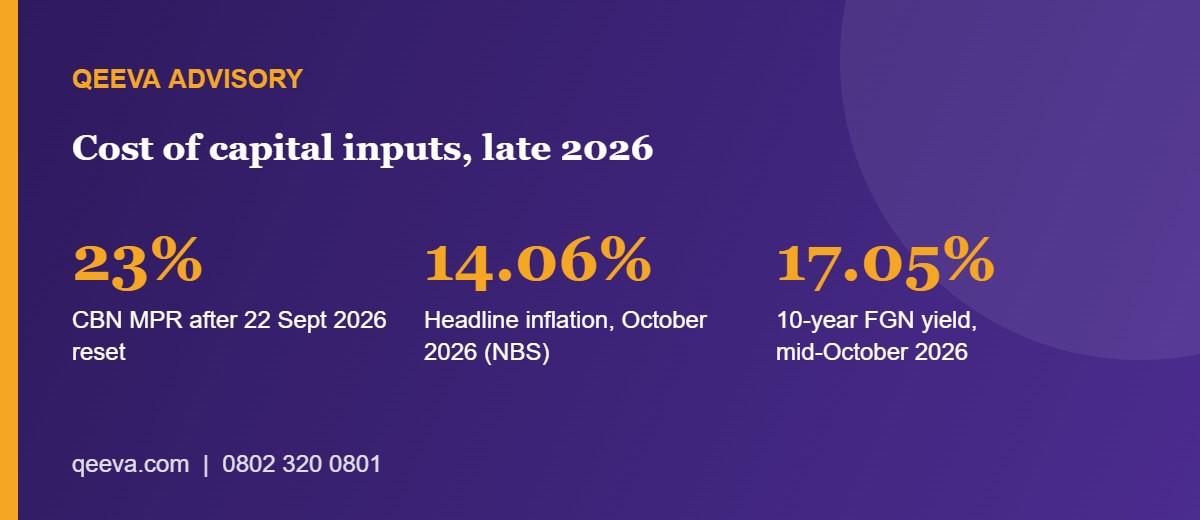
The inputs have shifted sharply this year. The Central Bank of Nigeria reset the Monetary Policy Rate to 23% on 22 September 2026, down from 26.5%. Headline inflation fell to 14.06% in October 2026, according to the National Bureau of Statistics. The 10-year FGN bond yield stood at 17.05% in mid-October.
Each of these moves changes the cost of capital. A discount rate set in 2024 or early 2026 is now out of date.
This guide explains how to build a defensible weighted average cost of capital (WACC) for a Nigerian private company, step by step, with a worked example and the mistakes that most often weaken a valuation.
What the discount rate does in a valuation
A discounted cash flow (DCF) valuation estimates the cash a business will generate in future and converts it into today’s value. The discount rate does that conversion. It reflects two things:
- The time value of money, since a naira today is worth more than a naira next year
- Risk, since investors demand a higher return for less certain cash flows
For valuing a whole business, the standard rate is the WACC. It blends the return shareholders require with the after-tax cost of debt, weighted by how the business is funded.
The formula is:
WACC = (E/V × Ke) + (D/V × Kd × (1 − t))
Where E is equity value, D is debt, V is E plus D, Ke is the cost of equity, Kd is the pre-tax cost of debt and t is the tax rate.
Step 1: Choose the risk-free rate
The risk-free rate is the return on an investment with almost no default risk in the valuation currency. For naira valuations, analysts use FGN bond yields.
Match the bond tenor to the length of your forecast. A five-year forecast with a terminal value usually calls for a 10-year bond yield. The 10-year FGN yield rose to 17.05% in the week ended 16 October 2026, according to market data reported by Aboki Forex.
Practical rules:
- Use the yield at the valuation date, not an annual average
- Use the Debt Management Office auction results or secondary market quotes and record the source
- Do not use the MPR as the risk-free rate. It is a policy rate, not an investable long-term return
- Do not use Treasury bill rates for long-horizon valuations
For a US dollar valuation, start from a US Treasury yield and add a country risk premium, or use Nigeria’s Eurobond yields. Never mix a naira risk-free rate with dollar cash flows.
Step 2: Estimate the cost of equity
Most valuers use the Capital Asset Pricing Model (CAPM), adjusted for private company risks:
Ke = Rf + (β × ERP) + size premium + specific risk premium
The equity risk premium
The equity risk premium (ERP) is the extra return investors expect from equities over the risk-free rate. There is no official Nigerian ERP. Valuers rely on published studies of mature-market premiums plus country risk, or on implied premiums from the Nigerian Exchange.
Pick a method, cite your source and apply it consistently. A valuation that uses 5% one year and 10% the next without explanation will not survive scrutiny from an auditor, the SEC or a tax authority.
Beta
Beta measures how sensitive a business is to market movements. Private companies have no traded share price, so valuers use the betas of listed comparable companies.
- Select listed peers in the same sector, in Nigeria or comparable markets.
- Unlever each peer’s beta to remove the effect of its debt.
- Take the median unlevered beta.
- Relever it using the target company’s capital structure.
The relevering formula is: βL = βU × (1 + (1 − t) × D/E)
Size and specific risk premiums
Small private companies carry risks a listed giant does not. Investors price these in:
- Size premium. Smaller firms have less diversified revenue, thinner management and harder access to capital.
- Specific risk premium. Customer concentration, key-person dependence, weak financial records, foreign exchange exposure or regulatory risk.
Document each premium with a reason. A specific risk premium added without explanation reads as a fudge factor.
Step 3: Estimate the cost of debt
The cost of debt is the rate the company would pay to borrow today, not the rate on a loan it took three years ago.
Sources to check:
- Current bank term loan offers to the company
- Recent facility letters
- Yields on corporate bonds or commercial paper of similar-risk issuers
- The MPR plus a typical bank margin, as a cross-check
The September 2026 cut in the MPR should feed into lending rates over time. Check whether your company’s banks have repriced facilities before you assume a lower rate.
Interest is generally tax-deductible, so use the after-tax cost: Kd × (1 − t). Under the Nigeria Tax Act 2025, companies that are not small companies pay companies income tax at 30%. Small companies pay 0%, so they get no tax shield from debt. Use the rate that applies to the business you are valuing, and check for interest deduction limits.
Step 4: Set the capital structure weights
Use the target or industry-typical capital structure, measured at market values, rather than the book figures on the balance sheet.
| Approach | When to use it | Watch out for |
|---|---|---|
| Target structure of the company | Management has a clear, financed funding plan | Optimistic plans that banks have not approved |
| Industry median of listed peers | Most minority and fair value valuations | Peers with very different business models |
| Current actual structure | Control valuations where the buyer keeps the structure | Book values that understate equity |
Step 5: Calculate and sense-check the WACC
Put the pieces together. Then check the answer against reality:
- Is the WACC above the risk-free rate? It must be.
- Is the cost of equity above the cost of debt? It should be.
- How does it compare with the returns private equity funds target in Nigeria?
- Would a buyer accept this return given current FGN bond yields?
Nominal and real rates must match the cash flows
This is the most common technical error in Nigerian valuations. If your cash flow forecast includes inflation, which most management forecasts do, use a nominal discount rate. If your forecast is in today’s prices, use a real rate.
The conversion uses the Fisher relationship: (1 + nominal) = (1 + real) × (1 + inflation)
With inflation at 14.06%, the gap between real and nominal rates is large. Mixing them can overstate or understate value by a wide margin.
A worked example
This example is illustrative. The company and inputs are invented to show the method and are not a recommendation for any specific valuation.
A Lagos logistics company with ₦4 billion turnover wants a valuation ahead of a minority equity raise. The valuer assembles these inputs:
| Input | Value | Basis |
|---|---|---|
| Risk-free rate | 17.0% | 10-year FGN yield, mid-October 2026 |
| Equity risk premium | 7.0% | Illustrative assumption |
| Relevered beta | 1.1 | Illustrative peer median |
| Size premium | 4.0% | Illustrative |
| Specific risk premium | 2.0% | Two customers make up 45% of revenue |
| Pre-tax cost of debt | 30.0% | Illustrative current bank offer |
| Tax rate | 30% | Nigeria Tax Act 2025 headline rate |
| Equity / debt weights | 70% / 30% | Industry median |
Cost of equity: 17.0% + (1.1 × 7.0%) + 4.0% + 2.0% = 30.7%
After-tax cost of debt: 30.0% × (1 − 0.30) = 21.0%
WACC: (70% × 30.7%) + (30% × 21.0%) = 21.49% + 6.30% = 27.8%
Now test sensitivity. Assume next year’s free cash flow is ₦500 million, growing at 10% a year in perpetuity. A simple growing perpetuity gives:
| WACC | Value (₦) |
|---|---|
| 25.0% | 500m ÷ (25.0% − 10%) = 3.33 billion |
| 27.8% | 500m ÷ (27.8% − 10%) = 2.81 billion |
| 30.0% | 500m ÷ (30.0% − 10%) = 2.50 billion |
A five-point swing in the discount rate moves value by ₦830 million. That is why each input needs evidence.
The real equivalent of the 27.8% nominal WACC, using October inflation, is about 12.0%: (1.278 ÷ 1.1406) − 1.
Common mistakes
- Using an old rate. A WACC from 2024 ignores the September 2026 MPR reset and the fall in inflation.
- Using the MPR as the risk-free rate. The MPR is a short-term policy tool, not a long-term investable yield.
- Mixing currencies. A naira risk-free rate with dollar cash flows, or the reverse.
- Mixing nominal and real. Inflated cash flows discounted at a real rate, or the reverse.
- Book value weights. Balance sheet equity often understates market value and distorts the WACC.
- Unsupported premiums. Size and specific risk premiums added without a written rationale.
- Double counting risk. Haircutting the cash flows for a risk and also adding a premium for it.
- Ignoring the tax status. Applying a 30% tax shield to a small company that pays 0% CIT.
- No sensitivity table. Presenting one value with no range.
When to update your discount rate
Revisit the WACC whenever:
- The CBN changes the MPR. The next MPC meeting is scheduled for 23 and 24 November 2026
- FGN bond yields move by more than one percentage point
- The company’s borrowing terms or capital structure change
- A transaction, fair value measurement or impairment test falls due
- The business’s risk profile shifts, for example after losing a major customer
For IFRS 13 fair value work and IAS 36 impairment tests, auditors expect the discount rate at the measurement date, with evidence.
Frequently asked questions
What risk-free rate should I use for a naira valuation in Nigeria?
Use the yield on an FGN bond with a tenor that matches your forecast horizon, usually the 10-year bond for a business valuation. The 10-year yield was 17.05% in mid-October 2026. Record the date and source of the yield you use.
Should I use the CBN Monetary Policy Rate as the discount rate?
No. The MPR, reset to 23% in September 2026, is a short-term policy rate. It signals the direction of interest rates but is not an investable long-term return. Use it only as a cross-check on the cost of debt.
How does the Nigeria Tax Act 2025 affect the WACC?
The tax rate sets the value of the interest tax shield. Companies that are not small pay companies income tax at 30%, so after-tax debt costs 70% of the pre-tax rate. Small companies pay 0% CIT and get no tax shield, so their after-tax and pre-tax cost of debt are the same.
What is a typical WACC for a Nigerian private company?
There is no single figure. It depends on sector, size, risk and funding. With 10-year FGN yields around 17%, most naira WACCs for private companies sit well above that level once equity risk, size and specific risks are added. Build the rate from evidence rather than adopting a typical number.
How often should a company update its discount rate?
At every valuation date, and whenever interest rates, bond yields, capital structure or business risk change materially. Given the September 2026 MPR reset and falling inflation, any rate set before then should be rebuilt.
How Qeeva Advisory can help
Qeeva Advisory prepares independent business valuations for capital raising, shareholder transactions, mergers, financial reporting and disputes. We build discount rates from current market evidence, document every assumption and present clear sensitivity analysis that investors, auditors and regulators can follow.
See our business valuation services, our corporate finance and capital raising advisory and our M&A due diligence support.
For a valuation or a review of your current discount rate, call 0802 320 0801 or 0807 576 5799, email info@qeeva.com, or visit our contact page.
This article is general information based on public data as at November 2026. Market rates change often. The worked example is illustrative. It is not investment, tax or valuation advice for any specific business. Consult a qualified adviser before relying on any discount rate.