Bank credit in Nigeria is expensive and hard to get. Many small and medium businesses that have customers, revenue and a clear plan still cannot meet collateral demands. Equity investors, for their part, rarely write cheques small enough for a growing bakery, a logistics start-up or a solar installer.
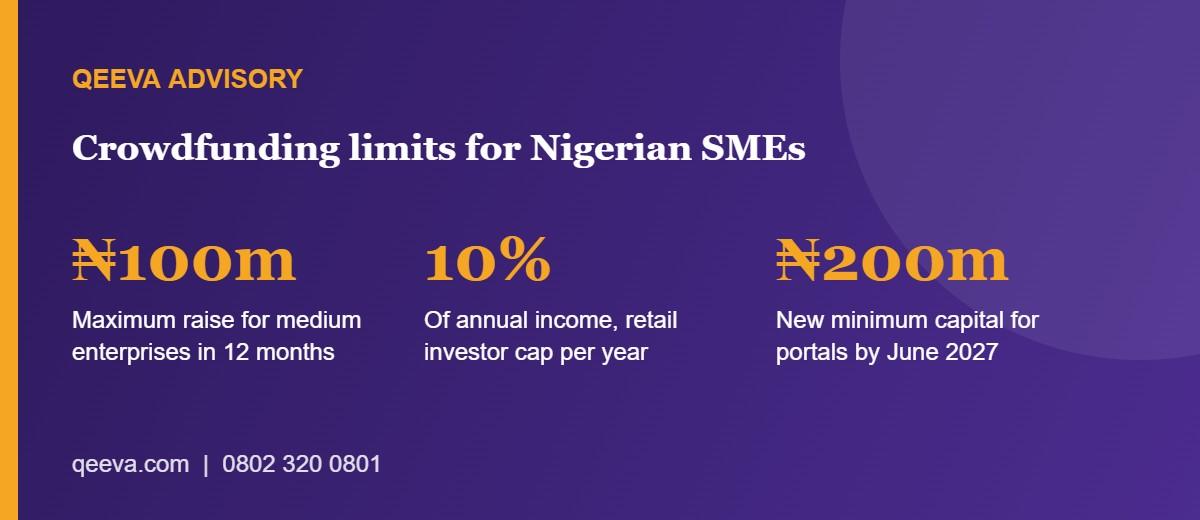
Regulated crowdfunding fills part of that gap. Under the Securities and Exchange Commission (SEC) Rules on Crowdfunding, a Nigerian micro, small or medium enterprise can raise between ₦50 million and ₦100 million in any 12-month period from many investors through an SEC-registered online portal. The Investment and Securities Act (ISA) 2025 now gives that framework firm statutory backing.
The window is real, but it is not easy money. The offer needs SEC clearance, full disclosure, a credible business plan and a sensible valuation. Investors are locked in for at least a year, and you take on a public shareholder base you must report to.
This guide explains who can raise, how much, what it costs, how the process runs, and how to decide whether crowdfunding beats a loan or a private placement for your business.
What regulated crowdfunding means in Nigeria
Crowdfunding here means raising money from members of the public through an online platform in exchange for shares, debt instruments or other investment returns. It is not donation-based fundraising. It is a securities offer, and the SEC regulates it.
The SEC issued its Rules on Crowdfunding on 21 January 2021. The full rules are on the SEC website. The ISA 2025 replaced the ISA 2007 and confirms the SEC’s power to regulate crowdfunding. As Financial Nigeria explained in August 2025, the new Act tightens one key point: offer materials cannot go up on a portal without prior SEC consent.
Three parties sit at the centre of every offer:
- The fundraiser. Your company, which issues the securities.
- The crowdfunding intermediary. An SEC-registered portal that hosts the offer, carries out due diligence and handles investor onboarding.
- The investors. Retail investors, high-net-worth individuals and qualified institutional investors who buy into the offer.
How much you can raise
The rules cap the amount a company can raise in any 12-month period. The cap depends on the size of the enterprise.
| Enterprise size | Maximum raise in 12 months |
|---|---|
| Micro enterprise | ₦50 million |
| Small enterprise | ₦70 million |
| Medium enterprise | ₦100 million |
| Commodities investment platform | ₦1 billion, which the SEC may raise on application |
The caps cover all crowdfunding offers combined, not each offer. If a small enterprise raises ₦40 million in March, it can raise only ₦30 million more before the following March.
Who can raise and who cannot
Eligibility is narrower than many founders expect. The fundraiser must be a company incorporated in Nigeria. A business name or sole proprietorship cannot issue securities.
| Eligible | Not eligible |
|---|---|
| Nigerian companies with at least two years of operating history | Public companies |
| Younger companies with a strong technical partner or sponsor with a verifiable track record | Banks, insurers, securities firms and oil and gas exploration companies |
| Start-ups, subject to enhanced due diligence and disclosure | Businesses with no clear business plan or revenue model |
| Cooperatives and community enterprises, with SEC approval | Businesses funding illegal or unethical activity |
If your business still trades as an enterprise registered with the Corporate Affairs Commission (CAC) as a business name, you will need to incorporate a private company and move the business into it first. Allow time for that, plus time to open bank accounts and transfer contracts.
Investor limits and protections
The rules protect retail investors by capping how much they can put in. A retail investor can invest no more than 10% of their annual income in a calendar year across all crowdfunding platforms. High-net-worth individuals and qualified institutional investors have no cap.
Other protections affect how you design your offer:
- Risk warnings. The portal must display risk warnings on its homepage, each subscription page and every application form.
- Risk acknowledgement. Each investor signs a form confirming they understand the risks, are within their limit and can bear a total loss.
- Lock-in. Investors accept a lock-in period of at least one year. They may never find a buyer for their shares.
- Disclosure. You must disclose material risks, financial information, use of proceeds and project details.
These rules shape your investor pitch. Retail investors with small tickets need a simple story, clear use of funds and realistic projections. Overpromising invites complaints and SEC attention.
The portals: why capital rules matter to you
Only SEC-registered crowdfunding intermediaries can host offers. The rules originally required a minimum paid-up capital of ₦100 million. In SEC Circular 26-1 of 16 January 2026, the Commission raised the minimum to ₦200 million, with a compliance deadline of 30 June 2027, as reported by Legal 500.
For a fundraiser, this matters in two ways. Some smaller portals may merge, recapitalise or exit before mid-2027. Choose a portal with the financial strength to see your offer and your post-raise reporting through. Ask any portal you shortlist for its SEC registration, its capital position and its plan to meet the new threshold.
The crowdfunding process step by step
A well-run raise takes about four to six months from decision to funds received. Here is the typical sequence.
| Stage | Key tasks | Typical time |
|---|---|---|
| 1. Readiness | Incorporate or restructure, clean up accounts, update CAC filings, fix tax compliance | 4 to 8 weeks |
| 2. Business plan and model | Write the plan, build a three to five year financial model, set use of proceeds | 3 to 4 weeks |
| 3. Valuation and structure | Value the company, choose shares or debt, set the price and minimum ticket | 2 to 3 weeks |
| 4. Portal selection | Shortlist SEC-registered portals, agree fees and due diligence scope | 2 weeks |
| 5. Due diligence and offer document | Portal reviews the business, offer document drafted | 3 to 4 weeks |
| 6. SEC clearance | Portal files the offer materials with the SEC for consent | 2 to 4 weeks |
| 7. Offer period | Marketing to investors, subscriptions collected | 4 to 8 weeks |
| 8. Closing and allotment | Funds released, shares allotted, CAC filings updated | 2 weeks |
Two steps decide most outcomes. The readiness stage, because a portal will reject a company with messy books or missing CAC returns. The valuation stage, because a price that is too high stalls subscriptions, and a price that is too low gives away the business.
Valuation: pricing your offer
Crowdfunding investors buy a stake at a price you set. The valuation you choose affects how much of the company you give away and how attractive the offer looks.
For an early-stage business, common methods include:
- Discounted cash flow (DCF). Values the business on projected cash flows. Best when you have a credible track record and a model the portal can test.
- Comparable transactions. Uses prices paid for similar Nigerian or African businesses. Useful as a sense check.
- Venture capital method. Works back from an expected exit value and target investor return. Common for start-ups with little profit history.
Whatever the method, the portal and investors will challenge your assumptions. Keep growth rates grounded in your own history and the market. Show the naira and dollar exposure in your cost base. With the Central Bank of Nigeria’s policy rate still high, investors expect returns that beat fixed income, so your projected return must be credible.
Worked example: a Lagos food processing company
This example is illustrative. The company and figures are for explanation only.
Ofada Foods Limited (a fictional name) packages local rice and spices. It is three years old, has annual revenue of ₦280 million and qualifies as a small enterprise. It wants ₦65 million to buy a second destoning and packaging line.
Its cap as a small enterprise is ₦70 million in 12 months, so ₦65 million fits.
Qeeva Advisory’s type of review would run as follows:
- Readiness. The company had not filed CAC annual returns for one year. It filed them and paid the penalty. It also reconciled VAT returns with its sales ledger.
- Valuation. A DCF based on the new line’s output gave a pre-money equity value of ₦520 million. A sense check against comparable deals supported a range of ₦450 million to ₦550 million.
- Structure. The company offered 11.1% of its enlarged share capital for ₦65 million, a post-money value of about ₦585 million. It set the minimum ticket at ₦100,000.
- Use of proceeds. ₦48 million for equipment, ₦9 million for installation and power upgrades, ₦5 million for working capital and ₦3 million for offer costs.
- Investor maths. A retail investor earning ₦6 million a year can invest up to ₦600,000 across all platforms in the year. The company planned for about 300 to 400 investors at an average of ₦180,000.
The offer closed fully subscribed after six weeks. The company then set up quarterly investor updates and an annual general meeting process for its new shareholder base.
Crowdfunding versus other funding routes
Crowdfunding is one option. Compare it honestly with the alternatives.
| Route | Best for | Main drawback |
|---|---|---|
| Bank loan | Businesses with collateral and steady cash flow | High interest, collateral demands |
| Development finance (BOI, DBN partner banks) | Manufacturers and agro-processors with bankable plans | Long processing time, strict documentation |
| Private placement to a few investors | Businesses with access to angels or family offices | Small pool, limited reach |
| Venture capital | High-growth tech businesses | Few cheques below ₦100 million, demanding terms |
| Regulated crowdfunding | Consumer-facing SMEs with a story the public understands | Disclosure, lock-in, reporting to many shareholders |
Consumer brands often do best. Their investors are also their customers, and a crowdfunding campaign doubles as marketing.
Common mistakes to avoid
- Raising before the books are clean. A portal’s due diligence will find unfiled returns, unreconciled VAT and missing board minutes. Fix them first.
- Overvaluing the business. A rich price stalls subscriptions and damages credibility if the raise fails.
- Ignoring the 12-month cap. Splitting one raise into several offers does not avoid the cap.
- Choosing a portal on fees alone. Check SEC registration, capital strength and track record.
- Vague use of proceeds. Investors want to see where every naira goes.
- No plan for shareholders. You will owe investors reports, meetings and answers. Build the process before you close.
- Promoting the offer off-platform without clearance. Marketing materials need SEC consent. Social media posts can count as offer materials.
Frequently asked questions
How much can a Nigerian SME raise through crowdfunding?
Under the SEC Rules on Crowdfunding, micro enterprises can raise up to ₦50 million, small enterprises up to ₦70 million and medium enterprises up to ₦100 million in any 12-month period. Commodities investment platforms have a ₦1 billion cap that the SEC may raise.
Can a business name registered with CAC raise money through crowdfunding?
No. The fundraiser must be a company incorporated in Nigeria. A business name or sole proprietorship would need to incorporate a private limited company and move the business into it first.
How much can individual investors put in?
Retail investors can invest up to 10% of their annual income per calendar year across all crowdfunding platforms. High-net-worth individuals and qualified institutional investors have no cap.
Do we need SEC approval for our offer?
Yes. Under the ISA 2025, offer materials cannot be posted on a portal without prior SEC consent. Your chosen intermediary files the materials with the SEC for clearance before the offer opens.
What is the new capital requirement for crowdfunding portals?
SEC Circular 26-1 of 16 January 2026 raised the minimum capital for crowdfunding intermediaries from ₦100 million to ₦200 million, with a compliance deadline of 30 June 2027.
How Qeeva Advisory can help
Qeeva Advisory prepares Nigerian businesses to raise capital and to keep investor confidence after the raise. We clean up CAC and tax compliance, restructure business names into companies, write investor-ready business plans and build financial models that stand up to portal due diligence. Our valuation team sets a defensible price, and our capital raising team helps you shortlist portals and structure the offer.
See our corporate finance and capital raising services, our business plan service, our business valuation services and our company formation and post-incorporation service.
To plan your crowdfunding raise, call 0802 320 0801 or 0807 576 5799, email info@qeeva.com, or visit our contact page.
This article is general guidance and does not constitute legal or investment advice. Crowdfunding limits and SEC requirements may change. Confirm current rules with the SEC and a registered crowdfunding intermediary before you raise.