Investors in Nigeria see hundreds of pitch decks a year. Most get less than five minutes of attention. The decks that win a meeting tell a clear story, back it with numbers and answer the questions an investor would otherwise have to ask.
Capital is scarce. The Guardian Nigeria reported that Nigerian startups attracted $343 million of the $3.2 billion raised by African startups in 2025. Local private equity, family offices, development finance institutions and banks are all more selective after two years of high interest rates and currency volatility.
That makes your deck more important, not less. A weak deck wastes the one chance you get with a busy investor. A strong one gets you to due diligence.
This guide sets out the 12 slides Nigerian and international investors expect, the numbers that must sit behind them, and the mistakes that kill a raise before it starts.
What a pitch deck is for
A pitch deck has one job: to earn the next meeting. It does not close the deal. The financial model, the data room and due diligence do that.
Think of the deck as a filter. The investor uses it to decide whether your business fits their mandate, whether the market is big enough and whether your team can execute. If the answer to all three is yes, they ask for more.
Most investors read decks in two settings. They skim a sent deck alone, often on a phone. Later they watch you present it. Build two versions: a reading deck with enough text to stand alone, and a presenting deck with fewer words that supports you in the room.
The 12 slides investors expect
| Slide | Question it answers | What to include |
|---|---|---|
| 1. Title | Who are you? | Company name, one-line description, raise amount, contact |
| 2. Problem | What pain exists? | A specific problem, who has it, what it costs them |
| 3. Solution | How do you fix it? | Your product or service and why it works |
| 4. Market | How big is the prize? | Total, serviceable and obtainable market in naira or dollars |
| 5. Product | What does it look like? | Screenshots, photos, process diagram |
| 6. Business model | How do you make money? | Pricing, unit economics, revenue streams |
| 7. Traction | Is it working? | Revenue, customers, growth rate, retention |
| 8. Competition | Who else is there? | Competitor map and your advantage |
| 9. Go-to-market | How will you grow? | Channels, partnerships, customer acquisition cost |
| 10. Team | Can you deliver? | Founders and key hires with relevant experience |
| 11. Financials | What do the numbers say? | Three to five year summary, key assumptions |
| 12. The ask | What do you need? | Amount, instrument, use of funds, runway |
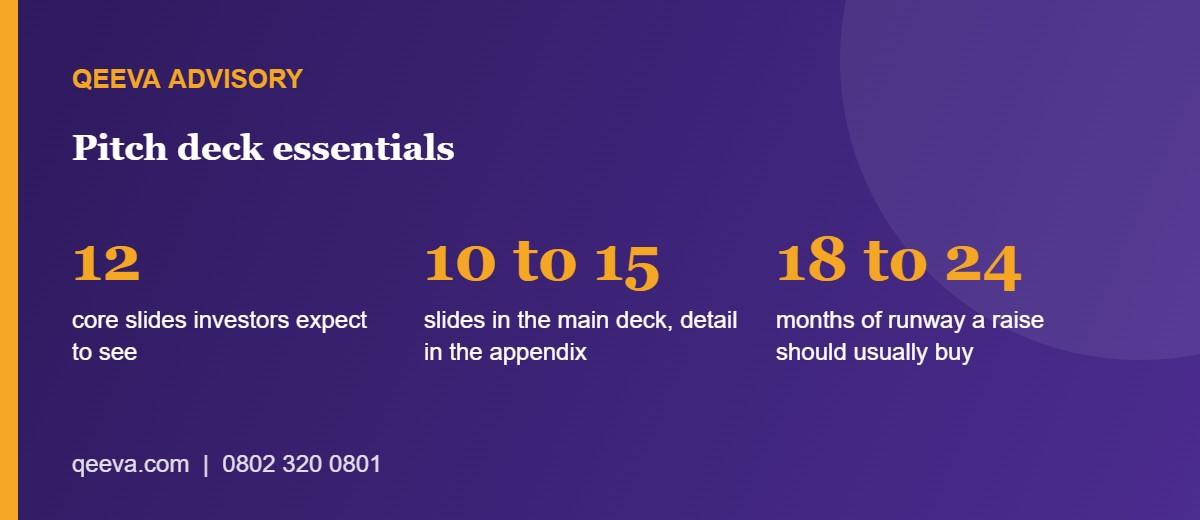
Keep the main deck to 10 to 15 slides. Put detail in an appendix.
Slide by slide: what good looks like
Problem
State one problem in plain words. “Nigerian SMEs struggle with finance” is too vague. “Small pharmacies in Lagos wait 21 days for supplier credit approval and lose sales when stock runs out” is specific.
Quantify the cost where you can. If you cite a figure, cite its source. Investors check.
Solution
Show how your product removes the pain. Use one sentence, then one picture. Avoid feature lists. Explain the outcome for the customer: faster, cheaper, safer or more reliable.
Market size
Investors want to see three numbers.
- Total addressable market (TAM): everyone who could buy your product.
- Serviceable addressable market (SAM): the part you can reach with your current model and geography.
- Serviceable obtainable market (SOM): the share you can realistically win in three to five years.
Build the numbers bottom-up. Count customers and multiply by what each pays. A bottom-up estimate of 40,000 pharmacies paying N50,000 a month is more credible than a top-down claim that the sector is worth $5 billion. Use public sources such as the National Bureau of Statistics, the CBN, industry associations and regulators.
Business model and unit economics
Explain who pays, how much and how often. Then show your unit economics:
- Customer acquisition cost (CAC)
- Average revenue per customer per month
- Gross margin
- Customer lifetime value (LTV)
- LTV to CAC ratio
- Payback period in months
Investors use these numbers to judge whether growth will create value or burn it. A business that spends N60,000 to win a customer who brings N8,000 of gross profit a month repays its acquisition cost in about seven to eight months. Show that maths.
Traction
Traction is the most persuasive slide. Show monthly revenue, active customers, growth rate and retention on a chart. Use real dates. If you are pre-revenue, show pilots, letters of intent, waitlists or partnerships.
Never inflate traction. Investors will check bank statements, management accounts and customer contracts during due diligence. One false number destroys trust in everything else.
Competition
Do not claim you have no competitors. Every customer has an alternative, even if it is a spreadsheet, a WhatsApp group or doing nothing.
Use a simple two-axis map or a comparison table. Explain why customers choose you. Strong advantages include proprietary data, regulatory licences, exclusive partnerships, cost structure and distribution reach.
Go-to-market
Explain how you acquire customers and what each channel costs. Name your channels: direct sales, agents, partnerships with banks or distributors, digital marketing, referrals. Show which channel works best today and how you plan to scale it.
Team
Show the founders and key hires. For each person, give one line of relevant experience. Investors back people as much as ideas. Name advisers only if they are active.
Address gaps honestly. If you need a chief financial officer, say so and show the role in your use of funds.
Financials
Show a summary of revenue, gross profit, operating costs, EBITDA and cash for three to five years. State the key assumptions: customer growth, pricing, churn, salaries and the exchange rate you used.
Investors in Nigeria pay close attention to currency. If you earn in naira and borrow or raise in dollars, show how a weaker naira affects your plan.
Keep the full model in the data room. The slide only needs the summary.
The ask
State exactly what you want.
- The amount you are raising
- The instrument: equity, convertible note, SAFE, debt or a mix
- The valuation or valuation cap, if you are ready to share it
- The use of funds, split by category
- The runway the raise buys, usually 18 to 24 months
- The milestones you will hit before the next raise
Investors want to see that the money buys measurable progress.
The numbers behind the deck
A deck without a model behind it fails at the first question. Before you send it, make sure you have:
- A three-statement financial model. Income statement, balance sheet and cash flow, linked and driven by assumptions.
- Management accounts. At least the last 12 months, reconciled to bank statements.
- Audited financial statements. For established companies, the last two or three years.
- A capitalisation table. Every shareholder, share class, option and convertible instrument.
- A use of funds schedule. Month-by-month spend for the runway period.
- Customer and revenue data. Monthly cohorts, churn and concentration.
Worked example: an illustrative agritech raise
The figures below are illustrative.
An Ogun State agritech company connects smallholder cassava farmers to processors. It wants to raise N750 million in equity.
| Item | Detail |
|---|---|
| Traction | 4,200 farmers onboarded, N310 million revenue in the last 12 months, 9% month-on-month growth |
| Unit economics | CAC of N12,000 per farmer, gross profit of N3,500 per farmer per month, payback under four months |
| Use of funds | N300 million working capital, N200 million aggregation centres, N150 million technology, N100 million team |
| Runway | 22 months |
| Milestones | 15,000 farmers, three new states, EBITDA break-even by month 20 |
The founders open with a farmer’s story, show the traction chart on slide 4, and keep the market slide to one bottom-up calculation. Their ask slide links every naira to a milestone. That structure tells the investor exactly what success looks like.
Tailor the deck to the investor
Different investors look for different things.
| Investor type | What they focus on |
|---|---|
| Angel investors | Founder quality, early traction, the size of the opportunity |
| Venture capital | Growth rate, market size, path to a large exit |
| Private equity | Profitability, cash flow, governance, audited accounts |
| Development finance institutions | Impact, job creation, environmental and social standards, bankability |
| Banks | Cash flow, collateral, repayment capacity, credit history |
Read the investor’s portfolio and mandate before you send the deck. Lead with the slide that matters most to them.
Nigerian considerations investors will raise
Investors in Nigerian businesses ask some questions every time. Answer them in the deck or the appendix.
- Company structure. Is the operating company registered with the Corporate Affairs Commission? Is there a holding company abroad? Is the cap table clean?
- Regulatory licences. Fintechs need CBN or SEC licences. Health businesses need approvals from bodies such as NAFDAC. Show what you hold and what you need.
- Tax position. Investors want evidence of tax registration and filing with the Nigeria Revenue Service and state revenue services. The Nigeria Tax Act 2025 changed many rules from 1 January 2026, so show that you have reviewed its effect.
- Data protection. If you handle customer data, show compliance with the Nigeria Data Protection Act 2023.
- Currency risk. Explain how you manage naira exposure.
- Startup Act benefits. The Nigeria Startup Act 2022 offers incentives to labelled startups. If you hold a startup label, say so.
Common mistakes to avoid
- Too many slides. A 40-slide deck signals that you cannot prioritise.
- Vague market claims. “A $10 billion market” with no source or method undermines credibility.
- Hockey-stick projections with no basis. Show the assumptions that drive growth and tie them to current performance.
- Hiding the ask. Investors should know how much you want within the first two minutes.
- Ignoring competition. Claiming none tells the investor you have not studied the market.
- Inconsistent numbers. Revenue on the traction slide must match the financials slide and the model.
- Messy cap table. Unrecorded share promises and verbal deals with early backers can stop a raise.
- No data room. When an investor asks for documents, send them within days, not weeks.
Frequently asked questions
How many slides should a pitch deck have?
Keep the main deck to 10 to 15 slides. Put supporting detail, such as full financials, customer case studies and team biographies, in an appendix or the data room.
Should I include a valuation in my pitch deck?
Include the amount you are raising and the instrument. Many founders leave the valuation for the first meeting so they can gauge investor interest. If you use a SAFE or convertible note, state the valuation cap and discount.
How far ahead should my financial projections go?
Show three to five years. Investors focus most on the next 18 to 24 months because that is the period your raise funds. Make the early years detailed and the later years directional.
Do I need audited accounts to raise capital in Nigeria?
Early-stage angel and venture investors often accept management accounts. Private equity funds, development finance institutions and banks usually ask for audited financial statements for the last two or three years.
How long does a capital raise take in Nigeria?
Plan for six to nine months from first meeting to money in the bank. Due diligence, legal documentation, regulatory approvals and, for foreign investors, capital importation steps all take time.
How Qeeva Advisory can help
Qeeva Advisory helps Nigerian businesses prepare for and complete capital raises. We build investor-grade financial models, write business plans, prepare pitch decks, organise data rooms and introduce you to suitable debt and equity investors.
Learn more about our capital raising assistance, our business plan service, our support with sourcing equity capital and our valuation services.
To prepare your raise, call 0802 320 0801 or 0807 576 5799, email info@qeeva.com, or visit our contact page.
Further reading: The Guardian Nigeria on 2025 startup funding and the Nigeria Data Protection Commission.
This article is general guidance and does not constitute investment, legal or financial advice. Seek professional advice before raising capital.