Franchising has built some of Nigeria’s best-known consumer brands. Quick service restaurants, pharmacies, schools, fitness centres, logistics agents, laundry services and retail outlets all use franchise models to expand faster than their own capital allows. International brands use franchising to enter Nigeria with local partners who understand the market.
Done well, franchising lets a brand owner grow with other people’s money and energy, while franchisees buy into a proven system with lower risk than starting from scratch. Done badly, it produces a network of underperforming outlets, damaged brand reputation, legal disputes and royalties that never arrive.
This guide explains how franchising works in Nigeria, the legal and regulatory points to address, how to price and value a franchise, and how both franchisors and franchisees can avoid the most common mistakes.
How franchising works
In a franchise, the franchisor grants the franchisee the right to operate a business using the franchisor’s brand, systems and know-how, in return for fees. The franchisee invests its own capital, runs the outlet, and follows the franchisor’s standards.
A typical franchise package includes:
- The right to use trademarks, trade names and branding.
- An operations manual covering products, processes, standards and customer service.
- Training for owners and staff.
- Site selection and fit-out guidance.
- Supply arrangements for key inputs.
- Marketing support, often funded by a shared marketing levy.
- Ongoing field support and quality audits.
In return, the franchisee usually pays:
- An initial franchise fee on signing.
- Ongoing royalties, often a percentage of sales.
- A marketing contribution, also usually a percentage of sales.
- Sometimes, mark-ups on supplies bought from the franchisor or approved suppliers.
Is your business ready to franchise?
Not every successful business can be franchised. Before offering franchises, a brand owner should be able to answer yes to most of these questions:
- Do we have at least one, and ideally several, profitable outlets that have operated for two or more years?
- Can our success be replicated by someone else following a manual, or does it depend on the founder’s personal involvement?
- Are our processes documented in enough detail to train a new operator?
- Is our brand protected by registered trademarks?
- Do our unit economics leave enough margin for the franchisee to make a good return after paying royalties?
- Do we have the people and systems to recruit, train and support franchisees?
- Can we control quality across outlets we do not own?
If the answers are mostly no, the business needs more groundwork before it franchises.
Legal and regulatory points in Nigeria
Nigeria does not have a single franchise law. Franchise relationships are governed by contract law and several regulatory regimes.
Trademarks
Register the brand’s trademarks with the Trademarks Registry in the relevant classes before signing any franchise agreement. A franchisor cannot license what it does not legally own. Franchisees should check that the trademarks are registered in the franchisor’s name.
NOTAP registration
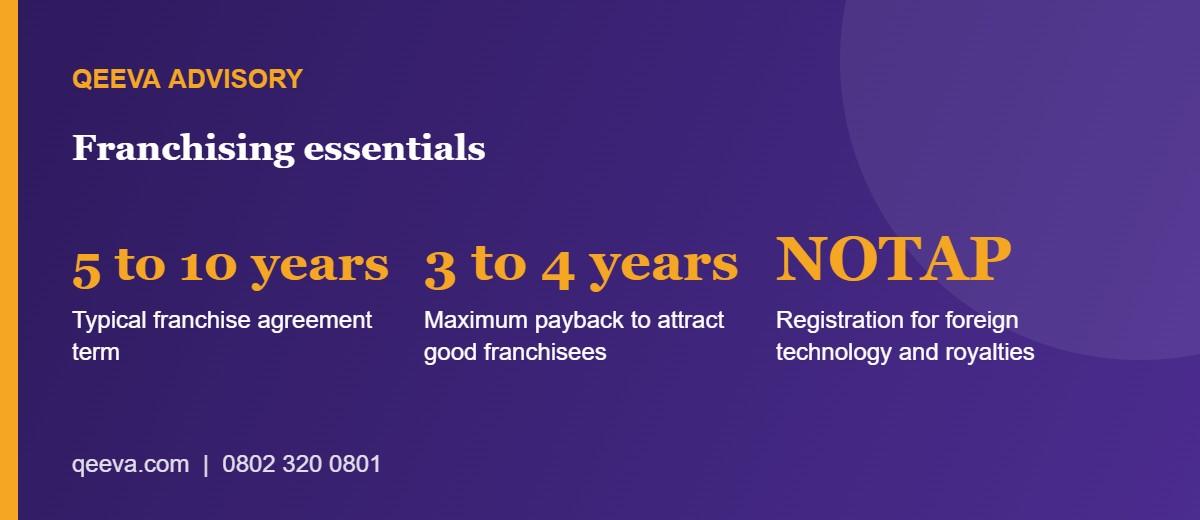
The National Office for Technology Acquisition and Promotion regulates agreements for the transfer of technology, including trademark licences, technical know-how, management services and franchise arrangements involving foreign parties. Registration with NOTAP is generally required before payments such as royalties and fees can be remitted abroad through official foreign exchange channels. NOTAP guidelines also limit the level of fees and royalties it will approve, usually as a percentage of net sales.
For international franchises entering Nigeria, NOTAP registration is a critical step. Local franchisors with only Nigerian franchisees should still take advice on whether any aspect of their arrangements falls within NOTAP’s scope.
Company and investment rules
Foreign franchisors operating through a Nigerian subsidiary must comply with CAMA 2020 and register with the Nigerian Investment Promotion Commission. Capital brought in to fund operations should be documented through a Certificate of Capital Importation.
Tax
Royalties and franchise fees have tax consequences on both sides. Withholding tax may apply to royalty payments, and VAT may apply to fees for services, including services imported from foreign franchisors. Franchisees must also handle company income tax, PAYE and other obligations as independent businesses. Under the Nigeria Tax Act 2025, check whether the franchisee qualifies as a small company and how the 4% Development Levy affects larger franchisees.
Sector regulation
Many franchise sectors are regulated: food businesses need NAFDAC and state health approvals, pharmacies need Pharmacy Council of Nigeria registration, schools need state education ministry approval. The franchise agreement should allocate responsibility for obtaining and maintaining licences.
The franchise agreement
The agreement is the foundation of the relationship. Key terms include:
| Term | What to address |
|---|---|
| Grant and territory | The rights granted and whether the territory is exclusive |
| Term and renewal | Duration, usually 5 to 10 years, and renewal conditions |
| Fees | Initial fee, royalties, marketing levy, payment dates and late payment interest |
| Standards | Compliance with the operations manual, audits and remedies for breaches |
| Supply | Required or approved suppliers and pricing |
| Training and support | What the franchisor provides and at whose cost |
| Reporting | Sales reports, financial statements and audit rights |
| Intellectual property | Use of brand, confidentiality and ownership of improvements |
| Transfer | Conditions for selling the franchise |
| Termination | Grounds, notice periods and post-termination obligations |
| Non-compete | Restrictions during and after the term, within lawful limits |
| Dispute resolution | Mediation, arbitration and governing law |
Pricing a franchise
Pricing must work for both parties. If royalties are too high, franchisees fail. If they are too low, the franchisor cannot fund support and the network deteriorates.
Start with the unit economics of a typical outlet:
- Investment required: fit-out, equipment, initial stock, deposits, licences and working capital.
- Expected sales by year, based on actual outlets in comparable locations.
- Operating costs: rent, staff, utilities, supplies and local marketing.
- Franchise fees: royalties and marketing levy.
- Franchisee profit and payback period.
A franchise that takes more than three to four years to pay back the franchisee’s investment will struggle to attract good operators, especially with Nigerian interest rates where they are.
Valuing a franchise business
Franchise businesses are valued at two levels.
Franchisor valuation. The franchisor’s value depends on recurring royalty income, the number and quality of franchisees, growth prospects, brand strength and the cost of supporting the network. Investors value predictable royalty streams highly, but they discount for franchisee concentration and failure rates.
Franchisee valuation. An individual outlet is valued on its cash flows after royalties, the remaining term of the franchise agreement, renewal prospects, and the transfer conditions in the agreement. A franchise outlet with two years left and uncertain renewal is worth much less than one with eight years remaining.
A worked example
A Lagos restaurant brand with four company-owned outlets wanted to expand to Abuja, Port Harcourt and Ibadan through franchising. Each outlet required an investment of about ₦85 million and generated annual sales of ₦240 million.
The proposed terms included an initial fee of ₦10 million, royalties of 6% of sales and a marketing levy of 2%. Financial modelling showed that a franchisee in a comparable location would earn an operating profit of about ₦28 million a year after fees, a payback of a little over three years.
The analysis also showed that two of the company’s own outlets would not have met the payback target after paying royalties, because of high rents. The brand adjusted its site selection criteria and reduced the fit-out specification to bring investment down before launching the franchise programme.
Figures are illustrative.
Advice for prospective franchisees
Before signing, a franchisee should:
- Speak to existing franchisees, including some who have left the network.
- Review audited accounts of the franchisor and, where available, outlet-level financial data.
- Model the business with realistic Nigerian costs, including generator fuel, rent increases and staff turnover.
- Check trademark registration and any NOTAP requirements.
- Have a lawyer review the agreement, especially termination, renewal and transfer terms.
- Understand exactly what support the franchisor provides.
Common mistakes
- Franchising before the model is proven.
- Weak operations manuals that leave too much to interpretation.
- Royalties set without testing franchisee profitability.
- Ignoring NOTAP requirements for foreign franchisors.
- Poor franchisee selection based only on ability to pay.
- No system for monitoring quality and collecting royalties.
Franchise models: single-unit, area and master
Franchisors can grant rights in different ways:
- Single-unit franchise. The franchisee operates one outlet. This gives the franchisor close control but slower growth.
- Area development. The franchisee commits to open several outlets in a defined territory over an agreed schedule. Growth is faster, but the franchisee needs more capital and management capacity.
- Master franchise. The master franchisee gets rights for a whole region or country and can sub-franchise to others. International brands often use this model to enter Nigeria, appointing one local partner to build the network.
Each model shifts risk, control and reward differently. Master franchise agreements need especially careful drafting on development schedules, royalty sharing and what happens if targets are missed.
Managing a franchise network
Signing franchisees is the start. Keeping the network healthy requires measurement and support. Track these indicators for every outlet each month:
- Sales and sales growth against comparable outlets.
- Royalty and marketing levy payments on time.
- Mystery shopping and quality audit scores.
- Customer complaints and reviews.
- Staff turnover and training completion.
- Compliance with supply arrangements.
Rank outlets and focus support on the bottom quarter. Early intervention saves franchisees who are struggling and protects the brand. Where a franchisee repeatedly breaches standards, follow the remedy process in the agreement and document every step.
Funding franchise expansion
Franchisees in Nigeria often struggle to raise the capital needed for fit-out and equipment. Franchisors can help by:
- Negotiating arrangements with banks or equipment lessors familiar with the brand.
- Providing audited outlet-level data that lenders can rely on.
- Offering staged fee payments or reduced initial fees for strong candidates.
- Preparing a standard bankable business plan template for franchisees.
A franchise system that helps franchisees access finance grows faster and attracts better operators.
Exit planning for franchisees
Franchisees should plan their exit from the start. Most agreements require the franchisor’s consent to sell an outlet, and may give the franchisor a right of first refusal. Know these terms, keep good records, and maintain standards, because a well-run outlet with years left on its agreement sells for far more than a struggling one near expiry.
Frequently asked questions
Is there a franchise law in Nigeria?
There is no single franchise statute. Franchising is governed by contract law and regulations covering trademarks, technology transfer through NOTAP, foreign investment, tax and sector licensing.
Do franchise agreements need NOTAP registration?
Agreements involving the transfer of foreign technology, trademarks or know-how generally need NOTAP registration, which is also usually required to remit royalties and fees abroad through official channels.
How much are franchise royalties in Nigeria?
Royalties are usually a percentage of sales and vary by sector and brand strength. Foreign franchise royalties are also subject to NOTAP guidelines. Royalties must leave franchisees with a reasonable return.
How is a franchise business valued?
Franchisors are valued mainly on recurring royalty income and network quality. Individual franchise outlets are valued on cash flows after fees and the remaining term of the agreement.
How long should a franchise agreement last?
Many franchise agreements run for five to ten years with renewal options, long enough for the franchisee to recover its investment and earn a return.
What is a master franchise?
An arrangement where one partner receives franchise rights for a whole region or country and can open outlets or sub-franchise to others, commonly used by international brands entering Nigeria.
How Qeeva Advisory can help
Qeeva Advisory Limited helps brand owners assess franchise readiness, build franchise financial models, prepare business plans and value franchise businesses. We also support prospective franchisees with due diligence and feasibility analysis. See our business plan service, business valuation service and expansion readiness service.
Plan your franchise programme: call 0802 320 0801 or 0807 576 5799, email info@qeeva.com, or visit www.qeeva.com.
This article is general information, not legal advice.