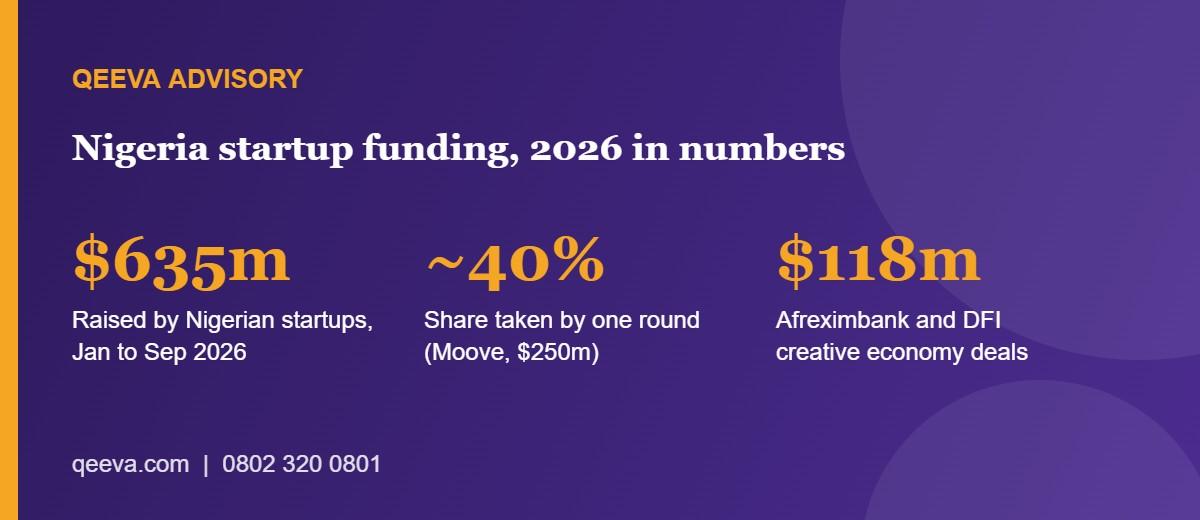
Nigerian startups raised $635 million in the first nine months of 2026, according to Africa: The Big Deal data reported by Nairametrics. That is more than double the same period in 2025 and the highest of any African country. On the surface, money is flowing again.
Look closer and the picture changes. One company, Moove, raised $250 million, almost 40% of the national total. In September 2026 only nine Nigerian startups raised money, $11.3 million between them. Across Africa, the number of startups that raised at least $100,000 fell 18%.
The lesson is simple. Capital is available, but it is going to fewer, better-prepared businesses. Founders who are not investment ready are being left behind.
The good news is that new public and development finance money is arriving, and it needs a pipeline of credible businesses. This article explains where that money is, what funders check, and how to become investment ready within 60 days.
New money on the table in November 2026
Three developments matter for Nigerian businesses raising money in 2027.
1. FG, JICA and NSIA startup funds. The Federal Government, the Japan International Cooperation Agency and the Nigeria Sovereign Investment Authority are working to set up six funds to finance startups. Fund sizes have not been published. These vehicles will need deal flow.
2. $118 million for the creative economy. At the Creative Africa Nexus in Lagos on 6 November, Afreximbank and Nigerian development finance institutions signed arrangements worth $118 million. They include a $75 million facility with the Development Bank of Nigeria, $30 million financing and a $13 million grant involving NEXIM and SMEDAN.
3. NITDA’s investment pipeline. NITDA is targeting a ₦3 billion investment pipeline and pilot contracts for startups through its builders festival. This is a target, not committed capital, but it signals where government attention is.
These sit alongside existing tools such as the Nigeria Startup Act’s seed fund, managed by NSIA.
Why good businesses still fail to raise
Nairametrics reported in October 2026 that Nigerian startups face a funding gap between seed money and the larger sums needed to scale. Investors at a November investor-matching programme said the challenge is often fit and preparation, not a shortage of capital.
In our experience, Nigerian businesses fail funding reviews for six recurring reasons:
- No credible financial model. Projections are a spreadsheet of hopes, not a model linked to drivers like customers, prices and costs.
- Unaudited or missing accounts. DFIs and serious investors want audited or at least reviewed financial statements.
- Unclear ownership. Cap tables that do not match CAC records, undocumented founder loans, or verbal share promises.
- No valuation logic. Founders quote a valuation they cannot defend.
- Weak governance. No board, no minutes, no conflict policy.
- Tax and regulatory gaps. Missing tax returns, no TIN, or expired permits.
Each of these can stop a deal at due diligence, even after a good pitch.
What DFIs and investors actually check
Development finance institutions such as DBN, NEXIM and their partner banks follow structured processes. Private investors move faster but ask similar questions. Expect them to look at:
| Area | What they ask for |
|---|---|
| Legal | CAC certificate, status report, memorandum and articles, shareholder register |
| Financial | Last two or three years of accounts, management accounts, bank statements |
| Tax | TIN, filed returns, tax clearance where required |
| Plan | Business plan with market evidence and use of funds |
| Model | Five-year financial model with scenarios |
| Valuation | Method and assumptions, especially for equity |
| Governance | Board composition, policies, key-person risk |
| Impact | For DFIs, jobs, exports, women and youth inclusion |
The creative economy facilities also expect businesses to show how cultural content becomes recurring revenue. That means contracts, licensing income and audience data, not just reputation.
A 60-day investment readiness plan
Days 1 to 10: Clean the corporate record. Reconcile your CAC records with your actual shareholders. Document founder loans and any promises of equity. File outstanding annual returns. Our company formation and post-incorporation service handles this.
Days 5 to 20: Fix the numbers. Close the last financial year. Prepare management accounts to date. Separate business and personal spending. If accounts are unaudited, plan the audit now.
Days 10 to 30: Build the financial model. Link revenue to customers, volumes and prices. Model costs that move with activity. Show three scenarios: base, downside and upside. Use a realistic exchange rate. The naira traded near ₦1,347/$ in early November, but a CBN-linked study warns that budget deficits pressure the currency over time. A model that only works at today’s rate is fragile.
Days 20 to 40: Write the business plan. Explain the problem, the market size with sources, your traction, competitors and the use of funds. Keep it short. Funders read dozens. See our business plan service.
Days 30 to 45: Prepare a valuation. Choose methods that suit your stage, such as discounted cash flow for revenue-generating firms or market comparables. Document assumptions. See our business valuation service.
Days 40 to 60: Assemble the data room. One folder with legal, financial, tax, model, plan, valuation and governance documents. Index it. Investors notice organised founders.
Nigerian realities to plan around
Elections. General elections take place in January 2027. Investors often pause around elections. Start conversations in late 2026 and aim to close or reach term sheets early in 2027.
Cheaper money. The CBN cut the Monetary Policy Rate to 23% in September 2026, and another Monetary Policy Committee meeting is set for 23 and 24 November. Lower rates improve debt affordability for businesses with steady cash flow. That makes blended equity and debt structures more realistic. Our debt and equity placement service can help structure the mix.
Tax incentives. NRS officials said in November 2026 that qualifying investments in eligible sectors, including the creative industry, can earn a 5% tax credit on capital expenditure of at least ₦250 million. Build this into your model if it applies.
Offshore options. The UK-Nigeria Tech Hub has encouraged founders to consider the UK as a fundraising market. Offshore structures bring legal and tax complexity, including capital importation documentation. Take advice before you restructure.
Equity, debt or grant: choose the right money
Many founders chase equity when a working capital loan would fit better. If the business succeeds, equity is the most expensive money you will ever raise. Match the source to your stage and cash flow.
| Source | Best fit | What you give up | Evidence funders expect |
|---|---|---|---|
| Angel investors | Early traction, small rounds | A share of ownership | Pitch deck, cap table, simple model |
| Venture capital | Fast-growing, scalable businesses | Ownership, a board seat, investor rights | Data room, growth metrics, reviewed or audited accounts |
| DFI loans through partner banks (DBN, BOI, NEXIM) | Businesses with steady cash flow | Interest, collateral, covenants | Audited accounts, tax clearance, cash flow forecast |
| Grants (SMEDAN and donor programmes) | Specific sectors or impact goals | Reporting duties | Eligibility documents, project budget |
| Strategic investor | Businesses needing distribution or supply | Control, exclusivity terms | Commercial plan, valuation |
Blended structures are now realistic. A founder might raise a modest equity round to strengthen the balance sheet, then use that equity to unlock a DFI-backed loan. Our debt and equity placement service builds these structures.
What your data room should contain
Investors judge you on how fast you answer their questions. A well-organised data room shortens due diligence by weeks. Set up seven folders:
- Corporate. CAC certificate, status report, memorandum and articles, shareholder register, board resolutions.
- Financial. Audited accounts, current management accounts, 12 months of bank statements, debtors and creditors ageing.
- Tax. TIN, filed returns, tax clearance certificate, VAT and PAYE remittance evidence.
- Commercial. Top customer contracts, key supplier agreements, sales pipeline.
- People. Organisation chart, key staff contracts, any share option plan.
- Legal and IP. Trademarks, licences, permits, a summary of any litigation.
- Deal documents. Financial model, business plan, valuation report.
Name files clearly and keep an index. Update the folder monthly while you raise.
Valuation: where Nigerian investors push back
Three points cause the most friction in negotiations.
Currency. Founders often quote dollar valuations on naira revenue. Investors discount for FX risk. Present the valuation in naira first, then convert at a stated rate and show what happens if the naira weakens by 10% or 20%.
Comparables. Valuation multiples from foreign markets or headline Lagos fintech rounds do not transfer to a logistics, agro-processing or retail business. Use comparables from your sector and region, and explain any premium you claim.
Discount rate. With the Monetary Policy Rate at 23%, investors expect high returns from Nigerian private companies. A discounted cash flow model that uses a low single-digit or low-teens discount rate will not survive the first meeting. Build the rate from Nigerian risk-free yields plus a credible risk premium. Our business valuation service prepares valuations that hold up in negotiation.
Red flags that end investor conversations
Experienced investors walk away when they see:
- Personal and business money mixed in the same account
- Revenue figures that differ between the pitch deck and the accounts
- Founders who cannot explain unit economics, such as customer acquisition cost and gross margin per unit
- A cap table with disputes or undocumented share promises
- No board oversight of the founder’s spending
- Unfiled tax returns or CAC annual returns
Each of these can be fixed within the 60-day plan above. Fix them before the first meeting, not after.
Questions to ask an investor before you accept
Due diligence runs both ways. The wrong investor can cost more than no investor. Before you sign a term sheet, ask:
- How many Nigerian businesses in your portfolio have raised a follow-on round, and who led it?
- What support do you give after the cheque, and who will sit on our board?
- What happens under your term sheet if we miss our targets?
- How do you treat currency risk on your investment, and do you require dollar-linked returns?
- Which other founders can we speak to, including one whose business struggled?
Listen closely to the answer on dollar-linked returns. An investor who requires repayment or preferred returns pegged to the dollar shifts FX risk onto a naira business. In a year when the naira could weaken after elections, that clause can decide whether the company survives.
Read the liquidation preference, anti-dilution and board control clauses with an adviser. These terms matter more than the headline valuation. A higher valuation with harsh terms often leaves founders worse off than a lower valuation with fair ones.
Frequently asked questions
What does investment ready mean for a Nigerian business?
It means your legal records, accounts, tax filings, financial model, business plan, valuation and governance can pass an investor’s or DFI’s due diligence without major gaps.
How much did Nigerian startups raise in 2026?
Africa: The Big Deal data show $635 million in the first nine months of 2026, with Moove’s $250 million round accounting for almost 40%.
What new funds are available?
The FG, JICA and NSIA are working on six startup funds, and Afreximbank and Nigerian DFIs signed $118 million for the creative economy in November 2026.
Do I need audited accounts to raise money?
Most DFIs and institutional investors expect audited or reviewed accounts. Angels may accept management accounts at seed stage.
How long does it take to become investment ready?
With focused work, many businesses can close the main gaps in about 60 days.
Should a Nigerian startup raise equity or debt?
It depends on cash flow. Businesses with steady revenue often suit debt from DFI partner banks. High-growth businesses without stable cash flow usually need equity first.
What goes into an investor data room?
Corporate records, financial statements, tax filings, key commercial contracts, people and legal documents, plus the financial model, business plan and valuation.
What should founders check before accepting an investor?
Their follow-on record, post-investment support, terms on missed targets, treatment of currency risk and references from other founders, including those whose businesses struggled.
How Qeeva Advisory can help
Qeeva Advisory Limited prepares business plans that have been used to raise equity and debt, builds financial models, performs business valuations and supports due diligence, company formation and corporate restructuring. We help founders and SME owners present evidence that funders can trust. Learn more about our startup finance and venture advisory service.
Start your readiness review: call 0802 320 0801 or 0807 576 5799, or email info@qeeva.com. Visit www.qeeva.com.
This article is general information, not investment advice.